Ch 14: Fluids and Elasticity
Knight Calc - Physics for Scientists and Engineers 5th Edition
Knight Calc5th EditionPhysics for Scientists and EngineersISBN: 9780137344796Not the one you use?Change textbook
Chapter 14, Problem 5

The deepest point in the ocean is 11 km below sea level, deeper than Mt. Everest is tall. What is the pressure in atmospheres at this depth?

Verified step by step guidance
1
Step 1: Understand the problem. The pressure at a depth in a fluid is determined by the hydrostatic pressure formula: \( P = P_0 + \rho g h \), where \( P_0 \) is the atmospheric pressure at the surface, \( \rho \) is the density of the fluid (in this case, seawater), \( g \) is the acceleration due to gravity, and \( h \) is the depth.
Step 2: Identify the known values. Atmospheric pressure at sea level \( P_0 \) is approximately 1 atmosphere. The density of seawater \( \rho \) is about \( 1025 \, \text{kg/m}^3 \). The acceleration due to gravity \( g \) is \( 9.8 \; \text{m/s}^2 \). The depth \( h \) is given as \( 11 \, \text{km} \), which needs to be converted to meters: \( h = 11 \times 1000 = 11000 \, \text{m} \).
Step 3: Substitute the values into the hydrostatic pressure formula. The pressure at depth \( P \) is given by \( P = P_0 + \rho g h \). Replace \( P_0 \) with \( 1 \, \text{atm} \), \( \rho \) with \( 1025 \, \text{kg/m}^3 \), \( g \) with \( 9.8 \; \text{m/s}^2 \), and \( h \) with \( 11000 \, \text{m} \).
Step 4: Convert the pressure from pascals to atmospheres. The hydrostatic pressure calculated using \( \rho g h \) will be in pascals (\( \text{Pa} \)). To convert to atmospheres, use the conversion factor: \( 1 \, \text{atm} = 101325 \, \text{Pa} \). Divide the pressure in pascals by \( 101325 \) to express the result in atmospheres.
Step 5: Add the atmospheric pressure at the surface to the converted hydrostatic pressure. The total pressure at depth is the sum of the atmospheric pressure \( P_0 \) and the pressure due to the water column. This gives the final pressure in atmospheres at the depth of \( 11 \, \text{km} \).

Verified video answer for a similar problem:

This video solution was recommended by our tutors as helpful for the problem above.
Video duration:
3m
Was this helpful?

Key Concepts

Here are the essential concepts you must grasp in order to answer the question correctly.

Hydrostatic Pressure

Hydrostatic pressure is the pressure exerted by a fluid at equilibrium due to the force of gravity. It increases with depth in a fluid, calculated using the formula P = ρgh, where P is pressure, ρ is the fluid density, g is the acceleration due to gravity, and h is the depth. In the ocean, the density of seawater is approximately 1025 kg/m³, which is essential for calculating the pressure at significant depths.
Recommended video:
Guided course
17:04
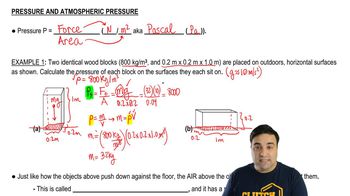
Pressure and Atmospheric Pressure

Atmospheric Pressure

Atmospheric pressure is the pressure exerted by the weight of the atmosphere above a given point. At sea level, this pressure is defined as 1 atmosphere (atm), equivalent to 101,325 pascals. When calculating pressure at depth, it is common to express the result in atmospheres, where the pressure increases by about 1 atm for every 10 meters of seawater depth.
Recommended video:
Guided course
17:04
Pressure and Atmospheric Pressure

Depth and Pressure Relationship

The relationship between depth and pressure in a fluid is linear, meaning that as depth increases, pressure increases proportionally. In the ocean, for every 10 meters of depth, the pressure increases by approximately 1 atm. Therefore, to find the total pressure at a specific depth, one must account for both the atmospheric pressure at the surface and the additional pressure due to the water column above.
Recommended video:
Guided course
17:04
Pressure and Atmospheric Pressure