Ch 14: Fluids and Elasticity
Knight Calc - Physics for Scientists and Engineers 5th Edition
Knight Calc5th EditionPhysics for Scientists and EngineersISBN: 9780137344796Not the one you use?Change textbook
Chapter 14, Problem 6

A 1.0-m-diameter vat of liquid is 2.0 m deep. The pressure at the bottom of the vat is 1.3 atm. What is the mass of the liquid in the vat?

Verified step by step guidance
1
Step 1: Understand the relationship between pressure, depth, and density. The pressure at the bottom of the vat is due to the weight of the liquid above it. The formula for pressure at a depth in a liquid is given by: P=Patm+ρgh, where P is the total pressure, Patm is atmospheric pressure, ρ is the density of the liquid, g is the acceleration due to gravity, and h is the depth of the liquid.
Step 2: Rearrange the formula to solve for the density of the liquid. Subtract atmospheric pressure from the total pressure to isolate the term related to the liquid: ρ=(P-Patm)gh. Use the given values: P=1.3 atm, Patm=1.0 atm, g=9.8 m/s², and h=2.0 m.
Step 3: Calculate the volume of the liquid in the vat. The vat is cylindrical, so the volume can be calculated using the formula for the volume of a cylinder: V=πr2h, where r is the radius of the vat and h is the depth. The diameter is given as 1.0 m, so the radius is r=0.5 m. Substitute r=0.5 m and h=2.0 m into the formula.
Step 4: Use the density and volume to calculate the mass of the liquid. The formula for mass is m=ρV, where ρ is the density and V is the volume. Substitute the values of ρ and V obtained from the previous steps.
Step 5: Ensure unit consistency throughout the calculations. Convert pressure from atm to Pascals (1 atm = 101325 Pa) and verify that all units are in SI (meters, kilograms, seconds). Perform the calculations step by step to find the mass of the liquid in the vat.

Verified video answer for a similar problem:

This video solution was recommended by our tutors as helpful for the problem above.
Video duration:
6m
Was this helpful?

Key Concepts

Here are the essential concepts you must grasp in order to answer the question correctly.

Hydrostatic Pressure

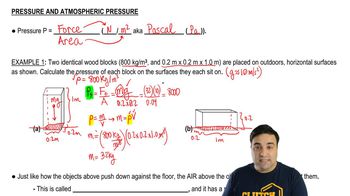
Hydrostatic pressure is the pressure exerted by a fluid at equilibrium due to the force of gravity. It increases with depth in a fluid and is calculated using the formula P = ρgh, where P is the pressure, ρ is the fluid density, g is the acceleration due to gravity, and h is the height of the fluid column.
Recommended video:
Guided course
17:04
Pressure and Atmospheric Pressure

Density

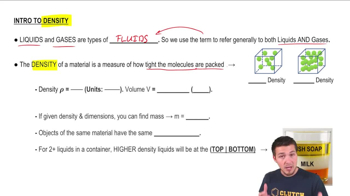
Density is a measure of mass per unit volume of a substance, typically expressed in kilograms per cubic meter (kg/m³). In the context of liquids, knowing the density allows us to relate mass and volume, as mass can be calculated using the formula m = ρV, where m is mass, ρ is density, and V is volume.
Recommended video:
Guided course
8:13
Intro to Density

Volume of a Cylinder

The volume of a cylinder can be calculated using the formula V = πr²h, where r is the radius and h is the height. In this case, the vat is cylindrical, and knowing its diameter allows us to find the radius, which is essential for determining the total volume of liquid in the vat and subsequently its mass.
Recommended video:
Guided course
05:21
Volume Thermal Expansion