Ch 14: Fluids and Elasticity
Knight Calc - Physics for Scientists and Engineers 5th Edition
Knight Calc5th EditionPhysics for Scientists and EngineersISBN: 9780137344796Not the one you use?Change textbook
Chapter 14, Problem 4b

50 cm³ of gasoline are mixed with 50 cm³ of water. What is the average density of the mixture?

Verified step by step guidance
1
Step 1: Recall the formula for density, which is \( \text{density} = \frac{\text{mass}}{\text{volume}} \). To find the average density of the mixture, we need the total mass and the total volume of the mixture.
Step 2: Determine the mass of each component. Use the formula \( \text{mass} = \text{density} \times \text{volume} \). Look up the densities of gasoline and water (e.g., \( \rho_{\text{gasoline}} \approx 0.7 \ \text{g/cm}^3 \) and \( \rho_{\text{water}} = 1.0 \ \text{g/cm}^3 \)). Then calculate the mass of gasoline and water using their respective volumes (50 cm³ each).
Step 3: Add the masses of gasoline and water to find the total mass of the mixture: \( \text{total mass} = \text{mass of gasoline} + \text{mass of water} \).
Step 4: Add the volumes of gasoline and water to find the total volume of the mixture: \( \text{total volume} = \text{volume of gasoline} + \text{volume of water} \).
Step 5: Calculate the average density of the mixture using the formula \( \text{average density} = \frac{\text{total mass}}{\text{total volume}} \). Substitute the total mass and total volume values obtained in the previous steps to find the result.

Verified video answer for a similar problem:

This video solution was recommended by our tutors as helpful for the problem above.
Video duration:
3m
Was this helpful?

Key Concepts

Here are the essential concepts you must grasp in order to answer the question correctly.

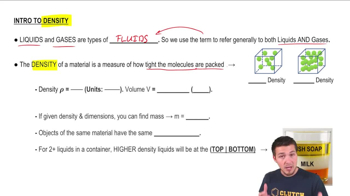
Density

Density is defined as mass per unit volume, typically expressed in grams per cubic centimeter (g/cm³) or kilograms per cubic meter (kg/m³). It is a fundamental property of materials that indicates how much mass is contained in a given volume. Understanding density is crucial for calculating the average density of a mixture, as it helps determine how different substances interact when combined.
Recommended video:
Guided course
8:13
Intro to Density

Mixture

A mixture is a combination of two or more substances where each retains its own properties. In this case, gasoline and water are mixed, but they do not chemically react. The average density of the mixture can be calculated by considering the individual densities and volumes of the components, which is essential for solving the problem presented.
Recommended video:
Guided course
04:27
Mixing Hot & Cold Water

Volume and Mass Relationship

The relationship between volume and mass is critical in density calculations. When mixing substances, the total volume of the mixture is the sum of the individual volumes, while the total mass is the sum of the individual masses. This relationship allows for the determination of the average density of the mixture by using the formula: average density = total mass / total volume.
Recommended video:
Guided course
05:21
Volume Thermal Expansion