Ch 14: Fluids and Elasticity
Knight Calc - Physics for Scientists and Engineers 5th Edition
Knight Calc5th EditionPhysics for Scientists and EngineersISBN: 9780137344796Not the one you use?Change textbook
Chapter 14, Problem 3

A 6.0 m ✕ 12.0 m swimming pool slopes linearly from a 1.0 m depth at one end to a 3.0 m depth at the other. What is the mass of water in the pool?

Verified step by step guidance
1
Determine the volume of the swimming pool by calculating the average depth. Since the pool slopes linearly, the average depth is the mean of the shallow and deep ends: \( \text{Average Depth} = \frac{1.0 \text{ m} + 3.0 \text{ m}}{2} \).
Calculate the total volume of the pool using the formula for the volume of a rectangular prism: \( \text{Volume} = \text{Length} \times \text{Width} \times \text{Average Depth} \). Here, \( \text{Length} = 12.0 \text{ m} \), \( \text{Width} = 6.0 \text{ m} \), and \( \text{Average Depth} \) is the value calculated in the previous step.
Recall that the density of water is approximately \( 1000 \text{ kg/m}^3 \). Use the relationship between mass, density, and volume: \( \text{Mass} = \text{Density} \times \text{Volume} \). Substitute the density of water and the volume of the pool into this formula.
Perform the multiplication to find the mass of the water in the pool. Ensure that the units are consistent throughout the calculation (e.g., meters for length, width, and depth, and kilograms for mass).
Express the final mass in kilograms (\( \text{kg} \)) and verify that the result is reasonable given the dimensions of the pool and the density of water.

Verified video answer for a similar problem:

This video solution was recommended by our tutors as helpful for the problem above.
Video duration:
4m
Was this helpful?

Key Concepts

Here are the essential concepts you must grasp in order to answer the question correctly.

Volume of a Trapezoidal Prism

The swimming pool can be modeled as a trapezoidal prism due to its sloping depth. The volume of such a prism is calculated using the formula V = A * h, where A is the area of the base and h is the height. In this case, the base area is a trapezoid formed by the varying depths, and the height is the length of the pool.
Recommended video:
Guided course
05:21
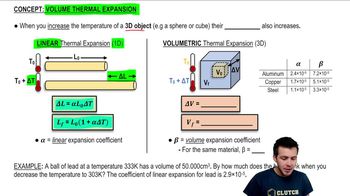
Volume Thermal Expansion

Density of Water

Density is a measure of mass per unit volume, commonly expressed in kg/m³. For water, the density is approximately 1000 kg/m³ at standard conditions. To find the mass of the water in the pool, the volume calculated from the trapezoidal prism must be multiplied by the density of water.
Recommended video:
Guided course
8:13
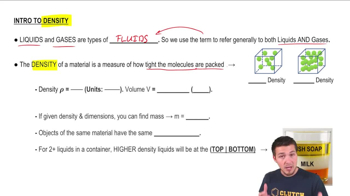
Intro to Density

Integration of Depths

Since the pool has a linear slope, the average depth can be used to simplify calculations. The average depth is the mean of the two depths (1.0 m and 3.0 m), which is 2.0 m. This average depth can be multiplied by the area of the base to find the total volume, making it easier to compute the mass of water.
Recommended video:
Guided course
11:43
Finding Moment Of Inertia By Integrating