
The tank shown in FIGURE CP14.73 is completely filled with a liquid of density ρ. The right face is not permanently attached to the tank but, instead, is held against a rubber seal by the tension in a spring. To prevent leakage, the spring must both pull with sufficient strength and prevent a torque from pushing the bottom of the right face out. What minimum spring tension is needed?
Ch 14: Fluids and Elasticity
Knight Calc5th EditionPhysics for Scientists and EngineersISBN: 9780137344796Not the one you use?Change textbook
Chapter 14, Problem 74
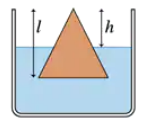
In FIGURE CP14.74, a cone of density ρ0 and total height l floats in a liquid of density ρf. The height of the cone above the liquid is h. What is the ratio h/l of the exposed height to the total height?

Verified step by step guidance1
Step 1: Begin by understanding the problem. The cone is floating in a liquid, and we need to find the ratio of the exposed height (h) to the total height (l). This involves applying principles of buoyancy and equilibrium.
Step 2: Use Archimedes' principle, which states that the buoyant force acting on the cone is equal to the weight of the liquid displaced by the submerged part of the cone. The buoyant force is given by: , where is the density of the liquid, is the acceleration due to gravity, and is the volume of the submerged part of the cone.
Step 3: The weight of the cone is given by: , where is the density of the cone and is the total volume of the cone.
Step 4: Set the buoyant force equal to the gravitational force to find the relationship between the submerged volume and the total volume: . The volume of a cone is proportional to the cube of its height, so , where is the submerged height and is the total height.
Step 5: Solve for the ratio using the relationship and the equation derived in Step 4. Substitute the values and simplify to find the final expression for .

Verified video answer for a similar problem:
This video solution was recommended by our tutors as helpful for the problem above.
Video duration:
7mWas this helpful?
Key Concepts
Here are the essential concepts you must grasp in order to answer the question correctly.
Buoyancy
Buoyancy is the upward force exerted by a fluid on an object submerged in it. This force is equal to the weight of the fluid displaced by the object, as described by Archimedes' principle. In this scenario, the cone experiences a buoyant force that balances its weight, allowing it to float. Understanding buoyancy is crucial for determining how much of the cone is submerged versus exposed.
Recommended video:
Guided course
Intro to Buoyancy & Buoyant Force
Density
Density is defined as mass per unit volume and is a key factor in determining whether an object will float or sink in a fluid. The densities of the cone (p₀) and the liquid (pβ) influence the buoyant force acting on the cone. If the density of the cone is less than that of the liquid, it will float, and the ratio of the heights h and l can be derived from their respective densities.
Recommended video:
Guided course
Intro to Density
Hydrostatic Pressure
Hydrostatic pressure is the pressure exerted by a fluid at equilibrium due to the weight of the fluid above it. In this context, the pressure at the base of the cone is determined by the height of the liquid column above it. This pressure must equal the weight of the cone for it to float, leading to a relationship between the submerged height and the total height of the cone, which is essential for solving the problem.
Recommended video:
Guided course
Pressure and Atmospheric Pressure
Related Practice
Textbook Question
2
views
Textbook Question
The tank shown in FIGURE CP14.73 is completely filled with a liquid of density ρ. The right face is not permanently attached to the tank but, instead, is held against a rubber seal by the tension in a spring. To prevent leakage, the spring must both pull with sufficient strength and prevent a torque from pushing the bottom of the right face out. If the spring has the minimum tension, at what height d from the bottom must it be attached?
1
views
Textbook Question
The bottom of a steel 'boat' is a 5.0 m x 10 m x 2.0 cm piece of steel (psteel = 7900 kg/m³). The sides are made of 0.50-cm-thick steel. What minimum height must the sides have for this boat to float in perfectly calm water?
1
views
