
Ch 14: Fluids and Elasticity
Knight Calc - Physics for Scientists and Engineers 5th Edition
Knight Calc5th EditionPhysics for Scientists and EngineersISBN: 9780137344796Not the one you use?Change textbook
Chapter 14, Problem 73b

The tank shown in FIGURE CP14.73 is completely filled with a liquid of density ρ. The right face is not permanently attached to the tank but, instead, is held against a rubber seal by the tension in a spring. To prevent leakage, the spring must both pull with sufficient strength and prevent a torque from pushing the bottom of the right face out. If the spring has the minimum tension, at what height d from the bottom must it be attached?

Verified step by step guidance
1
Understand the problem: The spring must be attached at a height such that it prevents both leakage and torque imbalance. This means the spring's force must counteract the torque caused by the liquid pressure on the right face of the tank.
Step 1: Calculate the torque due to the liquid pressure. The pressure at a depth \( h \) in a liquid is given by \( P = \rho g h \), where \( \rho \) is the liquid density, \( g \) is the acceleration due to gravity, and \( h \) is the depth. The force on a small strip of the right face at depth \( h \) is \( dF = P \cdot dA = \rho g h \cdot w \cdot dh \), where \( w \) is the width of the face and \( dA = w \cdot dh \) is the area of the strip.
Step 2: Determine the total torque about the bottom of the right face. The torque contribution from each strip is \( d\tau = dF \cdot h = \rho g h \cdot w \cdot h \cdot dh \). Integrate this expression over the height of the tank (from \( h = 0 \) to \( h = H \)) to find the total torque: \( \tau_{liquid} = \int_0^H \rho g h^2 w \, dh \). This evaluates to \( \tau_{liquid} = \frac{1}{3} \rho g w H^3 \).
Step 3: Relate the spring's force to the torque. The spring exerts a force \( F_s \) at a height \( d \) from the bottom. The torque due to the spring is \( \tau_{spring} = F_s \cdot d \). For equilibrium, the torque from the spring must balance the torque from the liquid: \( \tau_{spring} = \tau_{liquid} \), so \( F_s \cdot d = \frac{1}{3} \rho g w H^3 \).
Step 4: Solve for the height \( d \). Rearrange the equation \( F_s \cdot d = \frac{1}{3} \rho g w H^3 \) to find \( d = \frac{\frac{1}{3} \rho g w H^3}{F_s} \). This gives the height at which the spring must be attached to ensure equilibrium and prevent torque imbalance.

Verified video answer for a similar problem:

This video solution was recommended by our tutors as helpful for the problem above.
Video duration:
17m
Was this helpful?

Key Concepts

Here are the essential concepts you must grasp in order to answer the question correctly.

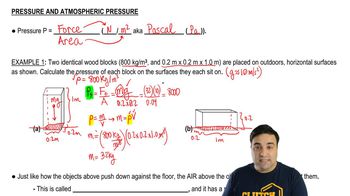
Hydrostatic Pressure

Hydrostatic pressure is the pressure exerted by a fluid at equilibrium due to the force of gravity. It increases with depth in the fluid and is given by the formula P = ρgh, where P is the pressure, ρ is the fluid density, g is the acceleration due to gravity, and h is the height of the fluid column above the point in question. Understanding hydrostatic pressure is crucial for analyzing forces acting on the tank's walls.
Recommended video:
Guided course
17:04
Pressure and Atmospheric Pressure

Torque

Torque is a measure of the rotational force applied to an object, calculated as the product of the force and the distance from the pivot point (T = Fd). In this context, it is important to consider how the pressure from the liquid creates a torque that could potentially push the right face of the tank outward. Balancing this torque with the tension in the spring is essential to prevent leakage.
Recommended video:
Guided course
08:55
Net Torque & Sign of Torque

Spring Tension

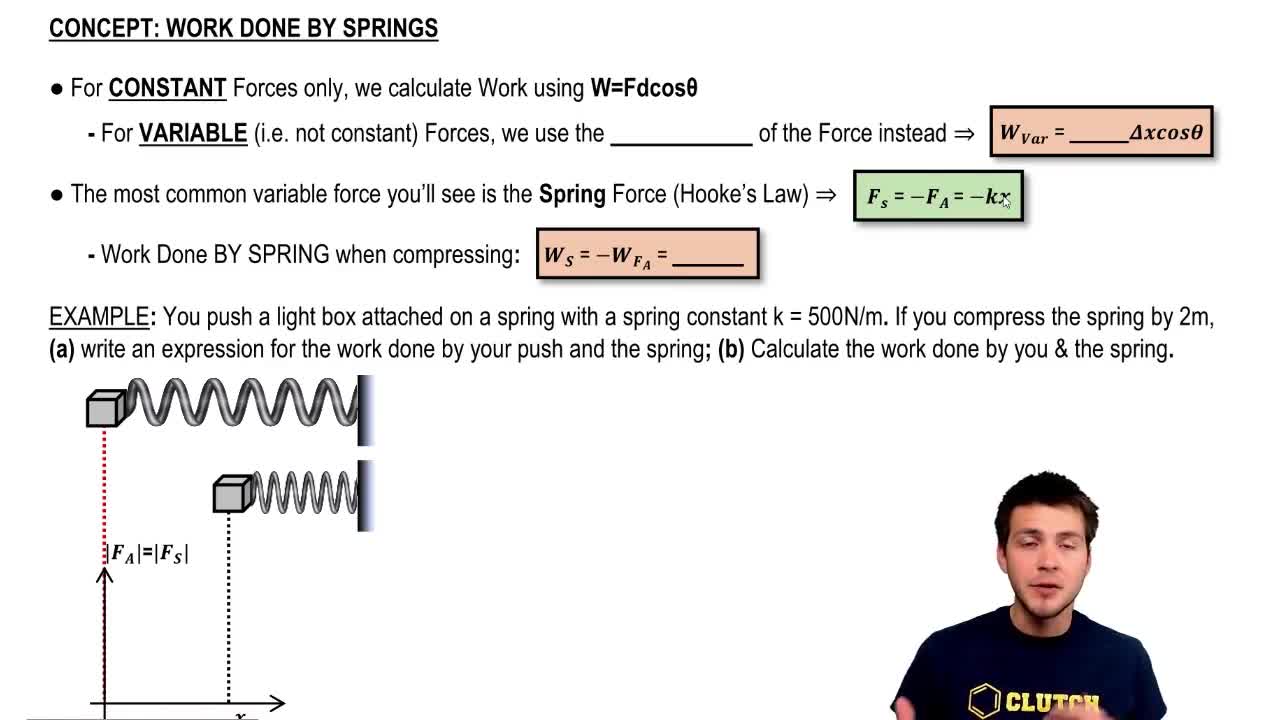
Spring tension refers to the force exerted by a spring when it is compressed or stretched from its equilibrium position. The tension in the spring must be sufficient to counteract both the hydrostatic pressure acting on the tank's right face and any torque that could cause the face to move. The relationship between the spring's tension and its attachment height is critical for ensuring the tank remains sealed.
Recommended video:
Guided course
05:58
Work Done By Springs