Ch 14: Fluids and Elasticity
Knight Calc - Physics for Scientists and Engineers 5th Edition
Knight Calc5th EditionPhysics for Scientists and EngineersISBN: 9780137344796Not the one you use?Change textbook
Chapter 14, Problem 71

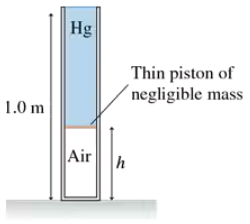
The 1.0-m-tall cylinder shown in FIGURE CP14.71 contains air at a pressure of 1 atm. A very thin, frictionless piston of negligible mass is placed at the top of the cylinder to prevent any air from escaping, then mercury is slowly poured into the cylinder until no more can be added without the cylinder overflowing. What is the height h of the column of compressed air? Hint: Boyle's law, which you learned in chemistry, says p₁V₁ = p₂V₂ for a gas compressed at constant temperature, which we will assume to be the case.

Verified step by step guidance
1
Step 1: Identify the initial conditions of the air in the cylinder. The initial pressure of the air is p₁ = 1 atm, and the initial volume is V₁ = A × h₁, where A is the cross-sectional area of the cylinder and h₁ = 1.0 m is the initial height of the air column.
Step 2: Recognize that as mercury is poured into the cylinder, the air is compressed. The final pressure of the air, p₂, will be equal to the atmospheric pressure plus the pressure exerted by the column of mercury. Use the formula for pressure due to a liquid column: p₂ = p₁ + ρ × g × h₂, where ρ is the density of mercury, g is the acceleration due to gravity, and h₂ is the height of the mercury column.
Step 3: Apply Boyle's law, which states that p₁ × V₁ = p₂ × V₂. Substitute the expressions for p₁, V₁, p₂, and V₂. Note that the final volume of the air, V₂, is given by A × h, where h is the compressed height of the air column.
Step 4: Solve for h, the height of the compressed air column. Rearrange the equation from Boyle's law to isolate h: h = (p₁ × h₁) / p₂. Substitute p₂ from Step 2 into this equation.
Step 5: Substitute the known values (p₁ = 1 atm, h₁ = 1.0 m, ρ for mercury, and g = 9.8 m/s²) into the equation to calculate h. Ensure unit consistency when performing the calculation.

Verified video answer for a similar problem:

This video solution was recommended by our tutors as helpful for the problem above.
Video duration:
18m
Was this helpful?

Key Concepts

Here are the essential concepts you must grasp in order to answer the question correctly.

Boyle's Law

Boyle's Law states that for a given mass of an ideal gas at constant temperature, the product of pressure and volume is constant (p₁V₁ = p₂V₂). This means that if the volume of the gas decreases, its pressure increases, and vice versa. In the context of the problem, as mercury is added to the cylinder, the volume of the air decreases, leading to an increase in pressure, which can be calculated using this law.
Recommended video:

Hydrostatic Pressure

Hydrostatic pressure is the pressure exerted by a fluid at equilibrium due to the force of gravity. It is calculated using the formula P = ρgh, where ρ is the fluid density, g is the acceleration due to gravity, and h is the height of the fluid column. In this scenario, the height of the mercury column will create a pressure that affects the air below the piston, which is crucial for determining the new height of the compressed air.
Recommended video:
Guided course
17:04
Pressure and Atmospheric Pressure

Ideal Gas Behavior

Ideal gas behavior refers to the assumptions made about gases that allow them to be modeled mathematically. These assumptions include that gas particles are in constant random motion, occupy negligible volume, and experience no intermolecular forces. While real gases deviate from this behavior under high pressure or low temperature, the ideal gas law provides a useful approximation for understanding the behavior of air in the cylinder as it is compressed by the mercury.
Recommended video:
Guided course
07:21
Ideal Gases and the Ideal Gas Law
Related Practice
Textbook Question

The 30-cm-long left coronary artery is 4.6 mm in diameter. Blood pressure drops by 3.0 mm of mercury over this distance. What are the (a) average blood speed and (b) volume flow rate in L/min through this artery?

1
views

Textbook Question

The tank shown in FIGURE CP14.73 is completely filled with a liquid of density ρ. The right face is not permanently attached to the tank but, instead, is held against a rubber seal by the tension in a spring. To prevent leakage, the spring must both pull with sufficient strength and prevent a torque from pushing the bottom of the right face out. What minimum spring tension is needed?

2
views
Textbook Question

The tank shown in FIGURE CP14.73 is completely filled with a liquid of density ρ. The right face is not permanently attached to the tank but, instead, is held against a rubber seal by the tension in a spring. To prevent leakage, the spring must both pull with sufficient strength and prevent a torque from pushing the bottom of the right face out. If the spring has the minimum tension, at what height d from the bottom must it be attached?

1
views
Textbook Question

The bottom of a steel 'boat' is a 5.0 m x 10 m x 2.0 cm piece of steel (psteel = 7900 kg/m³). The sides are made of 0.50-cm-thick steel. What minimum height must the sides have for this boat to float in perfectly calm water?

1
views
Textbook Question

20°C water flows through a 2.0-m-long, 6.0-mm-diameter pipe. What is the maximum flow rate in L/min for which the flow is laminar?

10
views
Textbook Question

20°C water flows at 1.5 m/s through a 10-m-long, 1.0-mm-diameter horizontal tube and then exits into the air. What is the gauge pressure in kPa at the point where the water enters the tube?

2
views