Ch 14: Fluids and Elasticity
Knight Calc - Physics for Scientists and Engineers 5th Edition
Knight Calc5th EditionPhysics for Scientists and EngineersISBN: 9780137344796Not the one you use?Change textbook
Chapter 14, Problem 11a

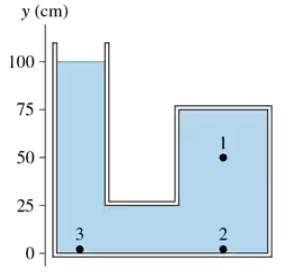
The container shown in FIGURE EX14.11 is filled with oil. It is open to the atmosphere on the left. What is the pressure at point 1?

Verified step by step guidance
1
Step 1: Identify the key concepts involved in the problem. This is a fluid mechanics problem, and the pressure at a given point in a fluid can be determined using the hydrostatic pressure formula. The formula is: P=Patm+ρgh, where Patm is atmospheric pressure, ρ is the density of the fluid, g is the acceleration due to gravity, and h is the depth of the fluid below the surface.
Step 2: Determine the atmospheric pressure. Since the container is open to the atmosphere on the left, the pressure at the surface of the oil is equal to the atmospheric pressure, Patm. This value is typically given in the problem or can be approximated as 101,325 Pa (standard atmospheric pressure).
Step 3: Identify the depth of point 1 below the surface of the oil. Measure or calculate the vertical distance h from the surface of the oil to point 1. This depth is crucial for calculating the hydrostatic pressure contribution.
Step 4: Use the density of the oil. The problem may provide the density of the oil, ρ, or you may need to look it up. Ensure the units are consistent (e.g., kg/m³).
Step 5: Substitute the values into the hydrostatic pressure formula. Combine the atmospheric pressure, the density of the oil, the acceleration due to gravity (g, approximately 9.8 m/s²), and the depth h to calculate the pressure at point 1 using the formula: P=Patm+ρgh.

Verified video answer for a similar problem:

This video solution was recommended by our tutors as helpful for the problem above.
Video duration:
1m
Was this helpful?

Key Concepts

Here are the essential concepts you must grasp in order to answer the question correctly.

Hydrostatic Pressure

Hydrostatic pressure is the pressure exerted by a fluid at rest due to the weight of the fluid above it. It increases with depth in a fluid and is calculated using the formula P = ρgh, where P is the pressure, ρ is the fluid density, g is the acceleration due to gravity, and h is the height of the fluid column above the point in question.
Recommended video:
Guided course
17:04
Pressure and Atmospheric Pressure

Atmospheric Pressure

Atmospheric pressure is the pressure exerted by the weight of the atmosphere above a given point. At sea level, this pressure is approximately 101,325 Pa (Pascals). In open containers, the pressure at the surface of the fluid is equal to the atmospheric pressure, which influences the pressure readings at various depths within the fluid.
Recommended video:
Guided course
17:04
Pressure and Atmospheric Pressure

Pascal's Principle

Pascal's Principle states that a change in pressure applied to an enclosed fluid is transmitted undiminished throughout the fluid. This principle is crucial for understanding how pressure is distributed in a fluid system, allowing us to determine the pressure at different points within the fluid, such as point 1 in the given question.
Recommended video:
Guided course
14:47
Diffraction with Huygen's Principle