Ch 14: Fluids and Elasticity
Knight Calc - Physics for Scientists and Engineers 5th Edition
Knight Calc5th EditionPhysics for Scientists and EngineersISBN: 9780137344796Not the one you use?Change textbook
Chapter 14, Problem 14

What is the minimum hose diameter of an ideal vacuum cleaner that could lift a 10 kg (22 lb) dog off the floor?

Verified step by step guidance
1
Identify the force needed to lift the dog. This is done by calculating the weight of the dog using the formula F = mg, where m is the mass of the dog and g is the acceleration due to gravity (approximately 9.8 m/s^2).
Determine the pressure difference required to lift the dog. Since the force exerted by the vacuum cleaner is due to the pressure difference between the atmospheric pressure and the pressure inside the vacuum, use the formula F = A \(\Delta\) P, where A is the cross-sectional area of the hose and \(\Delta\) P is the pressure difference.
Rearrange the formula to solve for the cross-sectional area A of the hose: A = F / \(\Delta\) P. Here, \(\Delta\) P can be assumed to be close to the atmospheric pressure (about 101,325 Pa) since the pressure inside an ideal vacuum cleaner can approach zero.
Calculate the diameter of the hose from the area. The area of a circle (which is the cross-section of the hose) is given by A = \(\pi\) (d/2)^2, where d is the diameter of the hose. Solve for d: d = 2 \(\sqrt{A / \pi}\).
Consider practical adjustments and safety factors, such as ensuring the diameter calculated is feasible for a vacuum cleaner and checking if the suction can be achieved without harming the dog.

Verified video answer for a similar problem:

This video solution was recommended by our tutors as helpful for the problem above.
Video duration:
6m
Was this helpful?

Key Concepts

Here are the essential concepts you must grasp in order to answer the question correctly.

Vacuum Pressure

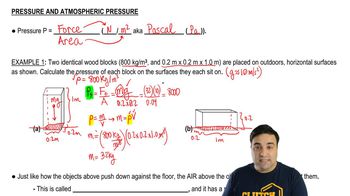
Vacuum pressure refers to the pressure difference created by a vacuum cleaner, which generates suction. It is the difference between atmospheric pressure and the pressure inside the vacuum cleaner's hose. To lift an object, the vacuum pressure must be sufficient to overcome the weight of the object, which can be calculated using the formula: Pressure = Force/Area.
Recommended video:
Guided course
17:04
Pressure and Atmospheric Pressure

Force and Weight

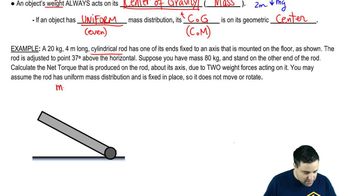
Force is a vector quantity that causes an object to accelerate, while weight is the force exerted by gravity on an object. The weight of an object can be calculated using the formula: Weight = mass × gravitational acceleration (approximately 9.81 m/s² on Earth). For a 10 kg dog, the weight would be 98.1 N, which is the force that the vacuum must counteract to lift the dog.
Recommended video:
Guided course
10:19
Torque Due to Weight

Hose Diameter and Flow Rate

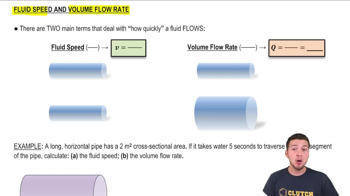
The diameter of the hose affects the flow rate of air and the vacuum cleaner's ability to create suction. A larger diameter allows for more air to flow, which can reduce the vacuum pressure, while a smaller diameter increases the velocity of the air, enhancing suction. The relationship between hose diameter, flow rate, and vacuum pressure is crucial for determining the minimum diameter needed to lift a specific weight.
Recommended video:
Guided course
6:34
Fluid Speed & Volume Flow Rate