Ch 14: Fluids and Elasticity
Knight Calc - Physics for Scientists and Engineers 5th Edition
Knight Calc5th EditionPhysics for Scientists and EngineersISBN: 9780137344796Not the one you use?Change textbook
Chapter 14, Problem 15

A 6.00-cm-diameter sphere with a mass of 89.3 g is neutrally buoyant in a liquid. Identify the liquid.

Verified step by step guidance
1
Determine the volume of the sphere using the formula for the volume of a sphere: V=43πr3, where r is the radius of the sphere. Convert the diameter (6.00 cm) to radius (3.00 cm) and substitute it into the formula.
Calculate the density of the sphere using the formula ρ=mV, where m is the mass of the sphere (89.3 g) and V is the volume calculated in the previous step. Ensure the units are consistent (e.g., convert mass to kilograms and volume to cubic meters if necessary).
Since the sphere is neutrally buoyant, its density is equal to the density of the liquid. This is because the buoyant force equals the gravitational force when an object is neutrally buoyant, implying that the densities are equal.
Identify the liquid by comparing the calculated density of the sphere (which is the same as the liquid's density) to known densities of liquids. Use a reference table of liquid densities to find the match.
Verify the result by ensuring the calculated density aligns with the physical properties of the identified liquid and that the assumptions made (e.g., neutral buoyancy) are valid for the problem.

Verified video answer for a similar problem:

This video solution was recommended by our tutors as helpful for the problem above.
Video duration:
3m
Was this helpful?

Key Concepts

Here are the essential concepts you must grasp in order to answer the question correctly.

Buoyancy

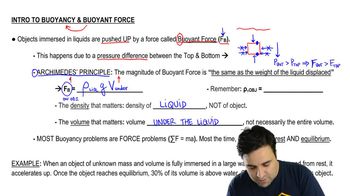
Buoyancy is the upward force exerted by a fluid on an object submerged in it. This force counteracts the weight of the object, allowing it to float or remain suspended. An object is neutrally buoyant when the buoyant force equals its weight, resulting in no net force acting on it.
Recommended video:
Guided course
11:06
Intro to Buoyancy & Buoyant Force

Density

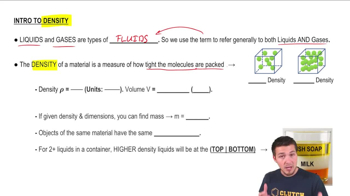
Density is defined as mass per unit volume and is a key factor in determining whether an object will float or sink in a fluid. For an object to be neutrally buoyant, its density must equal the density of the fluid it is in. The formula for density is ρ = m/V, where ρ is density, m is mass, and V is volume.
Recommended video:
Guided course
8:13
Intro to Density

Volume of a Sphere

The volume of a sphere can be calculated using the formula V = (4/3)πr³, where r is the radius of the sphere. This volume is essential for determining the density of the sphere when combined with its mass. In this case, knowing the diameter allows us to find the radius and subsequently the volume, which is necessary for identifying the liquid in which the sphere is neutrally buoyant.
Recommended video:
Guided course
05:21
Volume Thermal Expansion