
Ch 14: Fluids and Elasticity
Knight Calc - Physics for Scientists and Engineers 5th Edition
Knight Calc5th EditionPhysics for Scientists and EngineersISBN: 9780137344796Not the one you use?Change textbook
Chapter 14, Problem 23

Styrofoam has a density of 150 kg/m³. What is the maximum mass that can hang without sinking from a 50-cm-diameter Styrofoam sphere in water? Assume the volume of the mass is negligible compared to that of the sphere.

Verified step by step guidance
1
Determine the volume of the Styrofoam sphere using the formula for the volume of a sphere: V=43πr3, where the radius r is half the diameter (50 cm = 0.5 m).
Calculate the buoyant force acting on the sphere when it is fully submerged in water using Archimedes' principle: F=ρgV, where ρ is the density of water (1000 kg/m³), g is the acceleration due to gravity (9.8 m/s²), and V is the volume of the sphere.
Determine the weight of the Styrofoam sphere using the formula W=mg, where m is the mass of the sphere. The mass can be calculated using m=ρV, where ρ is the density of Styrofoam (150 kg/m³).
Find the maximum additional mass that can be hung from the sphere without sinking by equating the total weight (weight of the sphere + weight of the additional mass) to the buoyant force. Use the equation: F=W+mgextra, where mextra is the additional mass.
Solve for the maximum additional mass mextra by rearranging the equation: mextra=F-Wg. Substitute the values for the buoyant force, weight of the sphere, and gravitational acceleration to find the result.

Verified video answer for a similar problem:

This video solution was recommended by our tutors as helpful for the problem above.
Video duration:
8m
Was this helpful?

Key Concepts

Here are the essential concepts you must grasp in order to answer the question correctly.

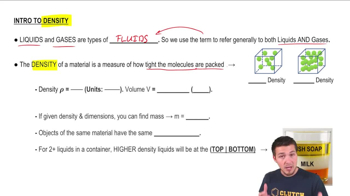
Density

Density is defined as mass per unit volume and is a crucial property of materials. In this context, the density of Styrofoam (150 kg/m³) indicates how much mass is contained in a given volume. Understanding density helps determine how much mass can be supported by the buoyant force when the Styrofoam sphere is submerged in water.
Recommended video:
Guided course
8:13
Intro to Density

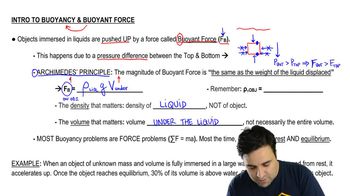
Buoyancy

Buoyancy is the upward force exerted by a fluid that opposes the weight of an object submerged in it. According to Archimedes' principle, the buoyant force on an object is equal to the weight of the fluid displaced by the object. This concept is essential for calculating the maximum mass that can hang from the Styrofoam sphere without sinking, as it determines how much weight the sphere can support.
Recommended video:
Guided course
11:06
Intro to Buoyancy & Buoyant Force

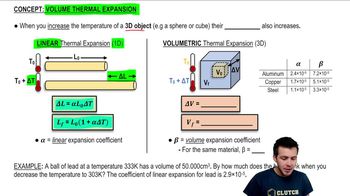
Volume of a Sphere

The volume of a sphere is calculated using the formula V = (4/3)πr³, where r is the radius. For a 50-cm-diameter sphere, the radius is 25 cm (0.25 m). Knowing the volume allows us to calculate the weight of the water displaced by the sphere, which is necessary to find the maximum mass that can be suspended without causing the sphere to sink.
Recommended video:
Guided course
05:21
Volume Thermal Expansion