
Ch 14: Fluids and Elasticity
Knight Calc - Physics for Scientists and Engineers 5th Edition
Knight Calc5th EditionPhysics for Scientists and EngineersISBN: 9780137344796Not the one you use?Change textbook
Chapter 14, Problem 29a

A 2.0 mL syringe has an inner diameter of 6.0 mm, a needle inner diameter of 0.25 mm, and a plunger pad diameter (where you place your finger) of 1.2 cm. A nurse uses the syringe to inject medicine into a patient whose blood pressure is 140/100. What is the minimum force the nurse needs to apply to the syringe?

Verified step by step guidance
1
Determine the pressure required to inject the medicine into the patient. The blood pressure of 140/100 mmHg corresponds to a systolic pressure of 140 mmHg. Convert this pressure to Pascals (Pa) using the conversion factor: 1 mmHg = 133.322 Pa. The required pressure is P = 140 × 133.322 Pa.
Calculate the cross-sectional area of the plunger pad where the nurse applies force. The diameter of the plunger pad is 1.2 cm, so the radius is r = 1.2 cm / 2 = 0.6 cm = 0.006 m. The area is given by A = πr², where r is the radius.
Relate the force applied by the nurse to the pressure in the syringe. The pressure in the syringe is given by P = F / A, where F is the force applied by the nurse and A is the cross-sectional area of the plunger pad. Rearrange this equation to solve for F: F = P × A.
Account for the pressure loss due to the narrow needle. The inner diameter of the needle is 0.25 mm, which is much smaller than the syringe's inner diameter of 6.0 mm. However, for this problem, we assume the pressure in the syringe is sufficient to overcome the resistance in the needle, so the pressure required to inject the medicine remains the same as the patient's blood pressure.
Substitute the values into the equation F = P × A to calculate the minimum force. Use the converted pressure (P) from step 1 and the cross-sectional area (A) from step 2 to find the force. Ensure all units are consistent (e.g., Pascals for pressure and square meters for area).

Key Concepts

Here are the essential concepts you must grasp in order to answer the question correctly.

Pressure

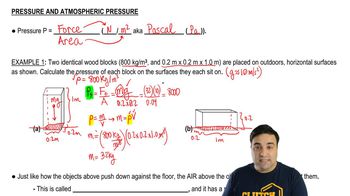
Pressure is defined as the force applied per unit area. In the context of the syringe, it is crucial to understand how the pressure exerted by the nurse's finger on the plunger translates into the force needed to inject the medicine. The relationship between pressure, force, and area is given by the formula P = F/A, where P is pressure, F is force, and A is the area over which the force is applied.
Recommended video:
Guided course
17:04
Pressure and Atmospheric Pressure

Hydraulic Systems

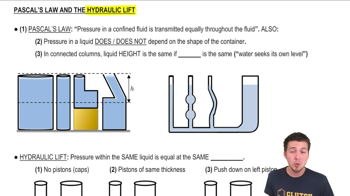
Syringes operate on the principle of hydraulic systems, where an incompressible fluid transmits pressure throughout the system. The force applied at the plunger is transmitted through the fluid to the needle, allowing the medicine to be injected. Understanding how pressure is maintained and transmitted in a hydraulic system is essential for calculating the force required to overcome the resistance of the fluid and the patient's blood pressure.
Recommended video:
Guided course
17:41
Pascal's Law and Hydraulic Lift

Blood Pressure

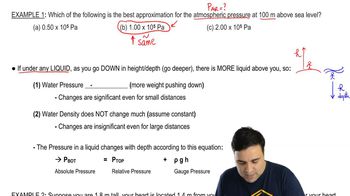
Blood pressure is the force exerted by circulating blood on the walls of blood vessels, typically measured in millimeters of mercury (mmHg). In this scenario, the patient's blood pressure of 140/100 mmHg indicates the pressure the nurse must overcome to inject the medicine. The systolic pressure (140 mmHg) represents the pressure during heartbeats, while the diastolic pressure (100 mmHg) represents the pressure between beats, both of which are critical for determining the minimum force needed.
Recommended video:
Guided course
15:27
Pressure In Air and In Liquids