Ch 04: Kinematics in Two Dimensions
Knight Calc - Physics for Scientists and Engineers 5th Edition
Knight Calc5th EditionPhysics for Scientists and EngineersISBN: 9780137344796Not the one you use?Change textbook
Chapter 4, Problem 35

Your roommate is working on his bicycle and has the bike upside down. He spins the 60-cm-diameter wheel, and you notice that a pebble stuck in the tread goes by three times every second. What are the pebble's speed and acceleration?

Verified step by step guidance
1
Determine the radius of the wheel. The diameter is given as 60 cm, so the radius \( r \) is half of the diameter: \( r = \frac{60}{2} = 30 \, \text{cm} = 0.30 \, \text{m} \).
Calculate the angular velocity \( \omega \) of the wheel. The pebble completes 3 revolutions per second, so the angular velocity is \( \omega = 2 \pi \times 3 = 6 \pi \, \text{rad/s} \).
Find the pebble's linear speed \( v \). The relationship between linear speed and angular velocity is \( v = r \omega \). Substitute \( r = 0.30 \, \text{m} \) and \( \omega = 6 \pi \): \( v = 0.30 \times 6 \pi \).
Determine the pebble's centripetal acceleration \( a_c \). The formula for centripetal acceleration is \( a_c = \frac{v^2}{r} \). Substitute \( v = 0.30 \times 6 \pi \) and \( r = 0.30 \): \( a_c = \frac{(0.30 \times 6 \pi)^2}{0.30} \).
Simplify the expressions for \( v \) and \( a_c \) to find the pebble's speed and acceleration. Ensure the units are consistent and the results are expressed in \( \text{m/s} \) for speed and \( \text{m/s}^2 \) for acceleration.

Verified video answer for a similar problem:

This video solution was recommended by our tutors as helpful for the problem above.
Video duration:
5m
Was this helpful?

Key Concepts

Here are the essential concepts you must grasp in order to answer the question correctly.

Linear Speed

Linear speed refers to the distance traveled by an object per unit of time. In this scenario, the pebble's speed can be calculated by determining the circumference of the bicycle wheel and multiplying it by the number of revolutions per second. The formula for linear speed (v) is v = distance/time, where the distance is the circumference of the wheel.
Recommended video:
Guided course
07:31
Linear Thermal Expansion

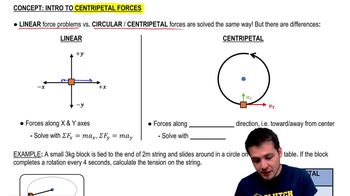
Centripetal Acceleration

Centripetal acceleration is the acceleration experienced by an object moving in a circular path, directed towards the center of the circle. It can be calculated using the formula a_c = v²/r, where v is the linear speed and r is the radius of the circular path. This concept is crucial for understanding how the pebble accelerates as it moves along the wheel's circular trajectory.
Recommended video:
Guided course
06:48
Intro to Centripetal Forces

Angular Velocity

Angular velocity is a measure of how quickly an object rotates around a central point, expressed in radians per second. It is related to the number of revolutions per second and can be calculated using the formula ω = 2πf, where f is the frequency of rotation. In this case, knowing the angular velocity helps in determining both the linear speed and the centripetal acceleration of the pebble.
Recommended video:
Guided course
06:18
Intro to Angular Momentum