Ch 04: Kinematics in Two Dimensions
Knight Calc - Physics for Scientists and Engineers 5th Edition
Knight Calc5th EditionPhysics for Scientists and EngineersISBN: 9780137344796Not the one you use?Change textbook
Chapter 4, Problem 43

Starting from rest, a DVD steadily accelerates to 500 rpm in 1.0 s, rotates at this angular speed for 3.0 s, then steadily decelerates to a halt in 2.0 s. How many revolutions does it make?

Verified step by step guidance
1
Step 1: Convert the angular speed from revolutions per minute (rpm) to radians per second (rad/s). Use the formula: \( \omega = \frac{\text{rpm} \times 2\pi}{60} \). Substitute \( \text{rpm} = 500 \) to find \( \omega \) in rad/s.
Step 2: Calculate the angular acceleration during the first phase (acceleration phase). Use the formula: \( \alpha = \frac{\Delta \omega}{\Delta t} \), where \( \Delta \omega \) is the change in angular velocity and \( \Delta t \) is the time interval (1.0 s).
Step 3: Determine the angular displacement during the acceleration phase using the kinematic equation: \( \theta = \omega_0 t + \frac{1}{2} \alpha t^2 \), where \( \omega_0 = 0 \) (starting from rest), \( \alpha \) is the angular acceleration, and \( t = 1.0 \) s.
Step 4: Calculate the angular displacement during the constant angular velocity phase. Use the formula: \( \theta = \omega t \), where \( \omega \) is the constant angular velocity (calculated in Step 1) and \( t = 3.0 \) s.
Step 5: Calculate the angular displacement during the deceleration phase. First, find the angular deceleration \( \alpha \) using \( \alpha = \frac{\Delta \omega}{\Delta t} \), where \( \Delta \omega \) is the change in angular velocity (from \( \omega \) to 0) and \( \Delta t = 2.0 \) s. Then, use the kinematic equation \( \theta = \omega_0 t + \frac{1}{2} \alpha t^2 \), where \( \omega_0 \) is the initial angular velocity (calculated in Step 1). Finally, sum up the angular displacements from all three phases and convert the total angular displacement from radians to revolutions using \( \text{revolutions} = \frac{\theta}{2\pi} \).

Verified video answer for a similar problem:

This video solution was recommended by our tutors as helpful for the problem above.
Video duration:
3m
Was this helpful?

Key Concepts

Here are the essential concepts you must grasp in order to answer the question correctly.

Angular Velocity

Angular velocity is the rate of change of angular displacement and is typically measured in radians per second or revolutions per minute (rpm). In this question, the DVD accelerates to an angular velocity of 500 rpm, which is crucial for calculating the total revolutions made during its motion.
Recommended video:
Guided course
06:18
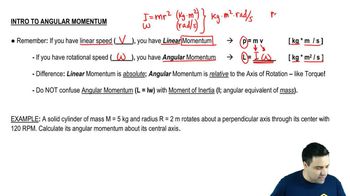
Intro to Angular Momentum

Angular Acceleration

Angular acceleration refers to the rate of change of angular velocity over time. It is essential for determining how quickly the DVD speeds up from rest to its maximum speed and then slows down to a stop. The acceleration phase lasts 1.0 s, while the deceleration phase lasts 2.0 s, both of which are key to calculating the total revolutions.
Recommended video:
Guided course
12:12
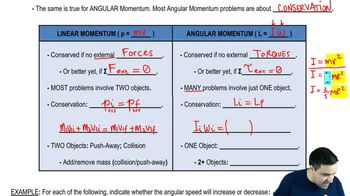
Conservation of Angular Momentum

Kinematic Equations for Rotational Motion

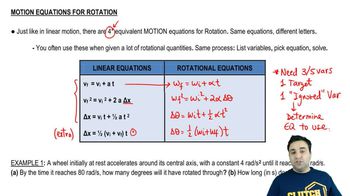
Kinematic equations for rotational motion are analogous to linear motion equations but apply to angular quantities. These equations allow us to relate angular displacement, angular velocity, and angular acceleration. They are used to calculate the total number of revolutions made by the DVD during its acceleration, constant speed, and deceleration phases.
Recommended video:
Guided course
07:18
Equations of Rotational Motion
Related Practice
Textbook Question

A projectile is launched from ground level at angle θ and speed v0 into a headwind that causes a constant horizontal acceleration of magnitude a opposite the direction of motion. Find an expression in terms of a and g for the launch angle that gives maximum range.

2
views
Textbook Question

FIGURE EX4.36 shows the angular velocity graph of the crankshaft in a car. What is the crankshaft's angular acceleration at t = 3s

1
views
Textbook Question

Your roommate is working on his bicycle and has the bike upside down. He spins the 60-cm-diameter wheel, and you notice that a pebble stuck in the tread goes by three times every second. What are the pebble's speed and acceleration?

2
views
Textbook Question

A projectile's horizontal range over level ground is v02sin2θg\(\frac{v_0^2 \sin 2\theta}{g}\). At what launch angle or angles will the projectile land at half of its maximum possible range?

1
views
Textbook Question

A spaceship maneuvering near Planet Zeta is located at r=(600i400j+200k)×103km,\(\mathbf{r}\) = (600\(\mathbf{i}\) - 400\(\mathbf{j}\) + 200\(\mathbf{k}\)) \(\times\) 10^3 \, \(\text{km}\), relative to the planet, and traveling at v=9500im/s\(\mathbf{v}\) = 9500\(\mathbf{i}\) \, \(\text{m/s}\). It turns on its thruster engine and accelerates with a=(40i20k)m/s2\(\mathbf{a}\) = (40\(\mathbf{i}\) - 20\(\mathbf{k}\)) \, \(\text{m/s}\)^2 for 35 min35\(\text{ min}\). What is the spaceship's position when the engine shuts off? Give your answer as a position vector measured in km\(\operatorname{km}\).

1
views
Textbook Question

A 5.0-m-diameter merry-go-round is initially turning with a 4.0 s period. It slows down and stops in 20 s. How many revolutions does the merry-go-round make as it stops?