Ch 04: Kinematics in Two Dimensions
Knight Calc - Physics for Scientists and Engineers 5th Edition
Knight Calc5th EditionPhysics for Scientists and EngineersISBN: 9780137344796Not the one you use?Change textbook
Chapter 4, Problem 44

A spaceship maneuvering near Planet Zeta is located at r=(600i400j+200k)×103km,\(\mathbf{r}\) = (600\(\mathbf{i}\) - 400\(\mathbf{j}\) + 200\(\mathbf{k}\)) \(\times\) 10^3 \, \(\text{km}\), relative to the planet, and traveling at v=9500im/s\(\mathbf{v}\) = 9500\(\mathbf{i}\) \, \(\text{m/s}\). It turns on its thruster engine and accelerates with a=(40i20k)m/s2\(\mathbf{a}\) = (40\(\mathbf{i}\) - 20\(\mathbf{k}\)) \, \(\text{m/s}\)^2 for 35 min35\(\text{ min}\). What is the spaceship's position when the engine shuts off? Give your answer as a position vector measured in km\(\operatorname{km}\).

Verified step by step guidance
1
Step 1: Convert the time duration from minutes to seconds. Since 1 minute equals 60 seconds, multiply 35 minutes by 60 to get the time in seconds.
Step 2: Use the kinematic equation for position: r_f = r_i + v_i t + (1/2) a t². Here, r_i is the initial position vector, v_i is the initial velocity vector, a is the acceleration vector, and t is the time duration.
Step 3: Substitute the given values into the equation. The initial position vector is r_i = (600î - 400ĵ + 200k) × 10³ km, the initial velocity vector is v_i = 9500î m/s, and the acceleration vector is a = (40î - 20k) m/s². Ensure all units are consistent, converting the position vector to meters by multiplying by 10³.
Step 4: Calculate each term in the equation. First, compute v_i t by multiplying the velocity vector by the time duration. Then compute (1/2) a t² by squaring the time duration, multiplying by the acceleration vector, and dividing by 2.
Step 5: Add the three vectors (r_i, v_i t, and (1/2) a t²) to find the final position vector. Convert the result back to kilometers by dividing by 10³.

Verified video answer for a similar problem:

This video solution was recommended by our tutors as helpful for the problem above.
Video duration:
15m
Was this helpful?

Key Concepts

Here are the essential concepts you must grasp in order to answer the question correctly.

Position Vector

A position vector describes the location of a point in space relative to a reference point, typically the origin of a coordinate system. In this context, the spaceship's position vector is given in kilometers and indicates its distance and direction from Planet Zeta. The components of the vector represent the distances along the x, y, and z axes, allowing for a three-dimensional representation of the spaceship's location.
Recommended video:
Guided course
07:07
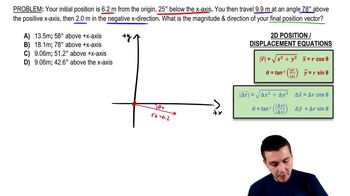
Final Position Vector

Acceleration

Acceleration is the rate of change of velocity of an object over time. It is a vector quantity, meaning it has both magnitude and direction. In this problem, the spaceship accelerates due to its thruster engine, which affects its velocity and ultimately its position. Understanding how to apply acceleration over a given time period is crucial for determining the final position of the spaceship after the engine shuts off.
Recommended video:
Guided course
05:47
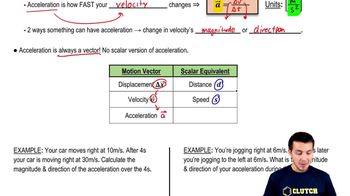
Intro to Acceleration

Kinematic Equations

Kinematic equations describe the motion of objects under constant acceleration. These equations relate displacement, initial velocity, final velocity, acceleration, and time. In this scenario, they are essential for calculating the spaceship's change in position due to its acceleration over a specified time interval. By applying these equations, one can determine the new position vector after the acceleration phase.
Recommended video:
Guided course
08:25
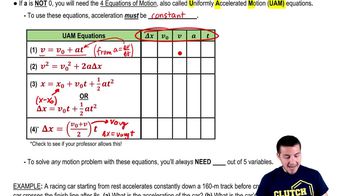
Kinematics Equations