
Ch 04: Kinematics in Two Dimensions
Knight Calc - Physics for Scientists and Engineers 5th Edition
Knight Calc5th EditionPhysics for Scientists and EngineersISBN: 9780137344796Not the one you use?Change textbook
Chapter 4, Problem 34b

A speck of dust on a spinning DVD has a centripetal acceleration of 20 m/s3 . What would be the acceleration of the first speck of dust if the disk's angular velocity was doubled?

Verified step by step guidance
1
Understand the relationship between centripetal acceleration and angular velocity. Centripetal acceleration (a_c) is given by the formula: ac=rω2, where r is the radius of the circular path and ω is the angular velocity.
Recognize that the centripetal acceleration is proportional to the square of the angular velocity. If the angular velocity is doubled, the centripetal acceleration will increase by a factor of 22, which is 4.
Set up the relationship between the initial centripetal acceleration and the new centripetal acceleration. Let the initial centripetal acceleration be ac=20 m/s2. The new centripetal acceleration will be 4×ac.
Substitute the given value of the initial centripetal acceleration into the equation for the new centripetal acceleration: ac,new=4×20.
Conclude that the new centripetal acceleration is four times the initial centripetal acceleration. Perform the multiplication to find the final value if needed.

Verified video answer for a similar problem:

This video solution was recommended by our tutors as helpful for the problem above.
Was this helpful?

Key Concepts

Here are the essential concepts you must grasp in order to answer the question correctly.

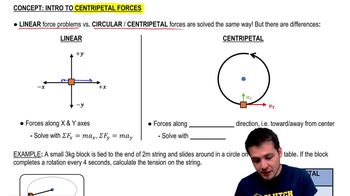
Centripetal Acceleration

Centripetal acceleration is the acceleration directed towards the center of a circular path that keeps an object moving in that path. It is calculated using the formula a_c = v^2 / r, where v is the tangential velocity and r is the radius of the circular path. This acceleration is crucial for understanding how objects behave in circular motion.
Recommended video:
Guided course
06:48
Intro to Centripetal Forces

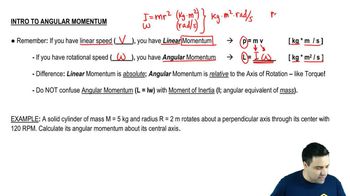
Angular Velocity

Angular velocity is a measure of how quickly an object rotates around a central point, typically expressed in radians per second. When the angular velocity of a rotating object increases, the tangential velocity of points on the object also increases, which directly affects the centripetal acceleration experienced by those points.
Recommended video:
Guided course
06:18
Intro to Angular Momentum

Relationship Between Angular Velocity and Centripetal Acceleration

The relationship between angular velocity and centripetal acceleration is defined by the equation a_c = r * ω^2, where ω is the angular velocity. If the angular velocity is doubled, the centripetal acceleration increases by a factor of four, since it is proportional to the square of the angular velocity. This concept is essential for predicting how changes in rotation affect acceleration.
Recommended video:
Guided course
03:43
Relationships Between Force, Field, Energy, Potential