
Ch 04: Kinematics in Two Dimensions
Knight Calc - Physics for Scientists and Engineers 5th Edition
Knight Calc5th EditionPhysics for Scientists and EngineersISBN: 9780137344796Not the one you use?Change textbook
Chapter 4, Problem 33b

The radius of the earth's very nearly circular orbit around the sun is 1.5 x 10¹¹ m. Find the magnitude of the earth's angular velocity.

Verified step by step guidance
1
Step 1: Recall the formula for angular velocity (ω), which is defined as the rate of change of angular displacement. For an object in circular motion, angular velocity is given by: ω=2πT, where T is the orbital period.
Step 2: Identify the orbital period (T) of the Earth around the Sun. The Earth completes one revolution around the Sun in approximately 1 year. Convert this time into seconds: T=365.25×24×60×60 seconds.
Step 3: Substitute the value of T into the formula for angular velocity: ω=2πT. This will give the angular velocity in radians per second.
Step 4: Simplify the expression by performing the division. Ensure that the units are consistent, and the result is expressed in radians per second.
Step 5: Interpret the result. The angular velocity represents how quickly the Earth sweeps out an angle in its orbit around the Sun, measured in radians per second.

Verified video answer for a similar problem:

This video solution was recommended by our tutors as helpful for the problem above.
Video duration:
2m
Was this helpful?

Key Concepts

Here are the essential concepts you must grasp in order to answer the question correctly.

Angular Velocity

Angular velocity is a measure of how quickly an object rotates around a central point or axis. It is defined as the rate of change of angular displacement and is typically expressed in radians per second. For circular motion, it can be calculated using the formula ω = θ/t, where θ is the angle in radians and t is the time taken. In the context of Earth's orbit, it indicates how fast the Earth is moving around the Sun.
Recommended video:
Guided course
06:18
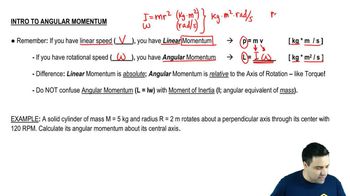
Intro to Angular Momentum

Centripetal Motion

Centripetal motion refers to the motion of an object that is moving in a circular path, requiring a net force directed towards the center of the circle. This force is essential for maintaining the circular trajectory and is provided by gravitational attraction in the case of planetary orbits. Understanding centripetal motion helps in analyzing the forces acting on the Earth as it orbits the Sun, which is crucial for calculating angular velocity.
Recommended video:
Guided course
06:48
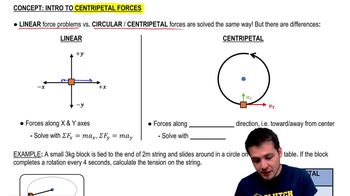
Intro to Centripetal Forces

Orbital Period

The orbital period is the time it takes for an object to complete one full orbit around another object. For Earth, this period is approximately one year (365.25 days). The relationship between the orbital period and angular velocity is given by the formula ω = 2π/T, where T is the orbital period. This concept is vital for determining the angular velocity of Earth in its orbit around the Sun.
Recommended video:
Guided course
04:45
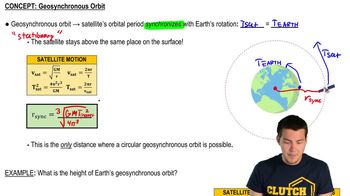
Geosynchronous Orbits