
Ch 04: Kinematics in Two Dimensions
Knight Calc - Physics for Scientists and Engineers 5th Edition
Knight Calc5th EditionPhysics for Scientists and EngineersISBN: 9780137344796Not the one you use?Change textbook
Chapter 4, Problem 33a

The radius of the earth's very nearly circular orbit around the sun is 1.5 x 10¹¹ m. Find the magnitude of the earth's velocity.

Verified step by step guidance
1
Step 1: Understand the problem. The Earth moves in a nearly circular orbit around the Sun, and we are tasked with finding the magnitude of its velocity. To calculate this, we can use the formula for orbital velocity: v = (2πr) / T, where r is the radius of the orbit and T is the orbital period.
Step 2: Identify the given values. The radius of the Earth's orbit is r = 1.5 × 10^11 m. The orbital period T is the time it takes for the Earth to complete one revolution around the Sun, which is approximately 1 year. Convert 1 year into seconds: T = 365.25 days × 24 hours/day × 3600 seconds/hour.
Step 3: Substitute the values into the formula for orbital velocity. Use the formula v = (2πr) / T, where r = 1.5 × 10^11 m and T is the orbital period in seconds.
Step 4: Simplify the expression. Calculate the numerator (2πr) and the denominator (T) separately, ensuring proper handling of scientific notation and units.
Step 5: Divide the numerator by the denominator to find the magnitude of the Earth's orbital velocity. Ensure the final units are in meters per second (m/s).

Verified video answer for a similar problem:

This video solution was recommended by our tutors as helpful for the problem above.
Video duration:
1m
Was this helpful?

Key Concepts

Here are the essential concepts you must grasp in order to answer the question correctly.

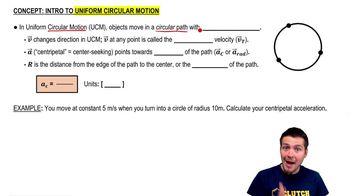
Circular Motion

Circular motion refers to the movement of an object along the circumference of a circle. In the context of the Earth's orbit, it describes how the planet travels in a nearly circular path around the Sun, maintaining a constant distance from the Sun. This motion is characterized by a constant speed but a changing velocity due to the continuous change in direction.
Recommended video:
Guided course
03:48
Intro to Circular Motion

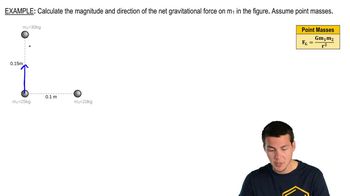
Gravitational Force

The gravitational force is the attractive force between two masses, described by Newton's law of universal gravitation. In the case of the Earth and the Sun, this force provides the necessary centripetal force that keeps the Earth in its orbit. The strength of this force depends on the masses of the two bodies and the distance between them.
Recommended video:
Guided course
05:41
Gravitational Forces in 2D

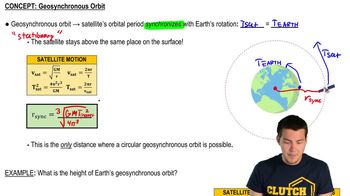
Orbital Velocity

Orbital velocity is the speed required for an object to maintain a stable orbit around a celestial body. It can be calculated using the formula v = √(GM/r), where G is the gravitational constant, M is the mass of the central body (the Sun), and r is the radius of the orbit (the distance from the Earth to the Sun). This velocity ensures that the gravitational pull and the object's inertia are balanced.
Recommended video:
Guided course
04:45
Geosynchronous Orbits