Ch 03: Vectors and Coordinate Systems
Knight Calc - Physics for Scientists and Engineers 5th Edition
Knight Calc5th EditionPhysics for Scientists and EngineersISBN: 9780137344796Not the one you use?Change textbook
Chapter 3, Problem 34

You are fixing the roof of your house when a hammer breaks loose and slides down. The roof makes an angle of 35° with the horizontal, and the hammer is moving at 4.5 m/s when it reaches the edge. What are the horizontal and vertical components of the hammer's velocity just as it leaves the roof?

Verified step by step guidance
1
Step 1: Understand the problem. The hammer is sliding down a roof inclined at an angle of 35° with the horizontal. Its velocity at the edge of the roof is 4.5 m/s. We need to find the horizontal and vertical components of this velocity.
Step 2: Recall the relationship between the components of velocity and the angle of inclination. The horizontal component of velocity (v_x) is given by v_x = v * cos(θ), and the vertical component of velocity (v_y) is given by v_y = v * sin(θ), where v is the magnitude of the velocity and θ is the angle of inclination.
Step 3: Substitute the given values into the formulas. The magnitude of the velocity (v) is 4.5 m/s, and the angle of inclination (θ) is 35°. Use the trigonometric functions cosine and sine to calculate the components.
Step 4: For the horizontal component, use the formula v_x = 4.5 * cos(35°). Ensure that the angle is in degrees if using a calculator or convert to radians if required by your calculation method.
Step 5: For the vertical component, use the formula v_y = 4.5 * sin(35°). Again, ensure the angle is correctly interpreted by your calculation method. These two components represent the hammer's velocity in the horizontal and vertical directions as it leaves the roof.

Verified video answer for a similar problem:

This video solution was recommended by our tutors as helpful for the problem above.
Video duration:
5m
Was this helpful?

Key Concepts

Here are the essential concepts you must grasp in order to answer the question correctly.

Vector Components

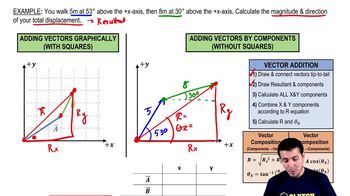
In physics, a vector can be broken down into its horizontal and vertical components. This is essential for analyzing motion in two dimensions. The horizontal component is found by multiplying the vector's magnitude by the cosine of the angle, while the vertical component is found by multiplying by the sine of the angle. This decomposition allows for easier calculations of motion in different directions.
Recommended video:
Guided course
07:30
Vector Addition By Components

Trigonometric Functions

Trigonometric functions, specifically sine and cosine, relate the angles of a triangle to the ratios of its sides. In this context, they are used to determine the components of the hammer's velocity based on the angle of the roof. For an angle θ, the cosine function gives the adjacent side (horizontal component), and the sine function gives the opposite side (vertical component). Understanding these functions is crucial for solving problems involving angles and motion.
Recommended video:
Guided course
08:30
Intro to Wave Functions

Kinematics

Kinematics is the branch of physics that describes the motion of objects without considering the forces that cause the motion. It involves concepts such as velocity, acceleration, and displacement. In this scenario, kinematics helps us analyze the hammer's motion as it transitions from the roof to free fall, allowing us to calculate its velocity components at the moment it leaves the roof.
Recommended video:
Guided course
08:25
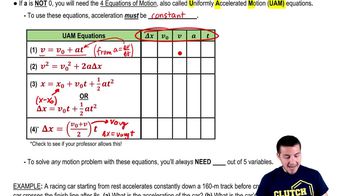
Kinematics Equations