
Ch 03: Vectors and Coordinate Systems
Knight Calc - Physics for Scientists and Engineers 5th Edition
Knight Calc5th EditionPhysics for Scientists and EngineersISBN: 9780137344796Not the one you use?Change textbook
Chapter 3, Problem 32

A cannon tilted upward at 30° fires a cannonball with a speed of 100 m/s. What is the component of the cannonball's velocity parallel to the ground?

Verified step by step guidance
1
Identify the given values: The angle of projection is 30° and the initial velocity of the cannonball is 100 m/s.
Understand that the velocity parallel to the ground corresponds to the horizontal component of the initial velocity.
Use the formula for the horizontal component of velocity: vx=vcosθ, where v is the initial velocity and θ is the angle of projection.
Substitute the given values into the formula: vx=100cos30°.
Simplify the expression to find the horizontal component of the velocity, ensuring the angle is in degrees if using a calculator.

Verified video answer for a similar problem:

This video solution was recommended by our tutors as helpful for the problem above.
Video duration:
4m
Was this helpful?

Key Concepts

Here are the essential concepts you must grasp in order to answer the question correctly.

Vector Components

In physics, vectors can be broken down into components that represent their influence in different directions. For projectile motion, the velocity vector can be divided into horizontal (x) and vertical (y) components. This is essential for analyzing motion, as each component can be treated independently.
Recommended video:
Guided course
07:30
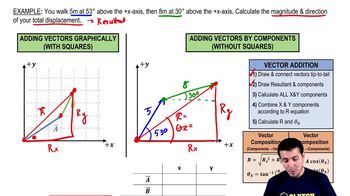
Vector Addition By Components

Trigonometric Functions

Trigonometric functions, such as sine and cosine, relate the angles of a triangle to the ratios of its sides. In the context of projectile motion, the cosine function is used to find the horizontal component of velocity, while the sine function is used for the vertical component. For an angle θ, the horizontal component is given by v*cos(θ).
Recommended video:
Guided course
08:30
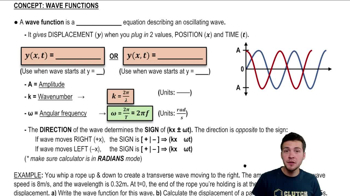
Intro to Wave Functions

Projectile Motion

Projectile motion describes the motion of an object that is launched into the air and is subject to gravitational force. The trajectory of the projectile can be analyzed using the initial velocity, launch angle, and the effects of gravity. Understanding this concept is crucial for solving problems related to the motion of objects like cannonballs.
Recommended video:
Guided course
04:44
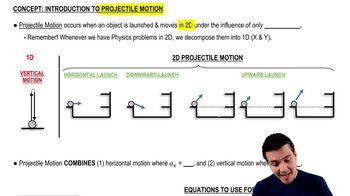
Introduction to Projectile Motion
Related Practice
Textbook Question

Ruth sets out to visit her friend Ward, who lives 50 mi north and 100 mi east of her. She starts by driving east, but after 30 mi she comes to a detour that takes her 15 mi south before going east again. She then drives east for 8 mi and runs out of gas, so Ward flies there in his small plane to get her. What is Ward's displacement vector? Give your answer (a) in component form, using a coordinate system in which the y-axis points north, and (b) as a magnitude and direction.

1
views
Textbook Question

While vacationing in the mountains you do some hiking. In the morning, your displacement is Smorning=(2000m,east)+(3000m,north)+(200m,vertical)\(\mathbf{S}\)_{morning} = (2000 \, \(\text{m}\), \(\text{east}\)) + (3000 \, \(\text{m}\), \(\text{north}\)) + (200 \, \(\text{m}\), \(\text{vertical}\)). Continuing on after lunch, your displacement is Safternoon=(1500m,west)+(2000m,north)(300m,vertical)\(\mathbf{S}\)_{afternoon} = (1500 \, \(\text{m}\), \(\text{west}\)) + (2000 \, \(\text{m}\), \(\text{north}\)) - (300 \, \(\text{m}\), \(\text{vertical}\)). What is the magnitude of your net displacement for the day?

3
views
Textbook Question

Jack and Jill ran up the hill at 3.0 m/s. The horizontal component of Jill's velocity vector was 2.5 m/s. What was the angle of the hill?

1
views
Textbook Question

A cannonball leaves the barrel with velocity v = (75î + 45ĵ). At what angle is the barrel tilted above horizontal?

Textbook Question

Trevon drives with velocity v1 = (55î - 10ĵ) mph for 1.0 h, then v2 = (20î + 50ĵ) mph for 2.0 h. What is Trevon's displacement? Write your answer in component form using unit vectors.

Textbook Question

You are fixing the roof of your house when a hammer breaks loose and slides down. The roof makes an angle of 35° with the horizontal, and the hammer is moving at 4.5 m/s when it reaches the edge. What are the horizontal and vertical components of the hammer's velocity just as it leaves the roof?

1
views