
Textbook Question
A cannon tilted upward at 30° fires a cannonball with a speed of 100 m/s. What is the component of the cannonball's velocity parallel to the ground?
1
views

 Verified step by step guidance
 06:13
06:13
 05:17
05:17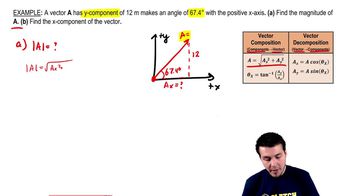 03:59
03:59A cannon tilted upward at 30° fires a cannonball with a speed of 100 m/s. What is the component of the cannonball's velocity parallel to the ground?
While vacationing in the mountains you do some hiking. In the morning, your displacement is . Continuing on after lunch, your displacement is . What is the magnitude of your net displacement for the day?
A cannonball leaves the barrel with velocity v = (75î + 45ĵ). At what angle is the barrel tilted above horizontal?
Trevon drives with velocity v1 = (55î - 10ĵ) mph for 1.0 h, then v2 = (20î + 50ĵ) mph for 2.0 h. What is Trevon's displacement? Write your answer in component form using unit vectors.
You are fixing the roof of your house when a hammer breaks loose and slides down. The roof makes an angle of 35° with the horizontal, and the hammer is moving at 4.5 m/s when it reaches the edge. What are the horizontal and vertical components of the hammer's velocity just as it leaves the roof?
While vacationing in the mountains you do some hiking. In the morning, your displacement is . Continuing on after lunch, your displacement is . At the end of the hike, how much higher or lower are you compared to your starting point?