
Textbook Question
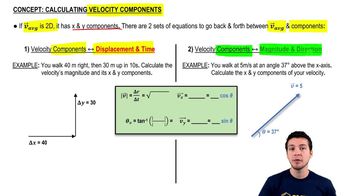
A jet plane taking off from an aircraft carrier has acceleration a = ( 15 m/s², 22° above horizontal). What are the horizontal and vertical components of the jet's acceleration?
1
views

 Verified step by step guidance
 05:53
05:53
 13:46
13:46 08:30
08:30A jet plane taking off from an aircraft carrier has acceleration a = ( 15 m/s², 22° above horizontal). What are the horizontal and vertical components of the jet's acceleration?
Jack and Jill ran up the hill at 3.0 m/s. The horizontal component of Jill's velocity vector was 2.5 m/s. What was the angle of the hill?
Kami is walking through the airport with her two-wheeled suitcase. The suitcase handle is tilted 40° from vertical, and Kami pulls parallel to the handle with a force of 120 N. (Force is measured in newtons, abbreviated N.) What are the horizontal and vertical components of her applied force?
A cannonball leaves the barrel with velocity v = (75î + 45ĵ). At what angle is the barrel tilted above horizontal?
Your neighbor Paul has rented a truck with a loading ramp. The ramp is tilted upward at 25°, and Paul is pulling a large crate up the ramp with a rope that angles 10° above the ramp. If Paul pulls with a force of 550 N, what are the horizontal and vertical components of his force? (Force is measured in newtons, abbreviated N.)
You are fixing the roof of your house when a hammer breaks loose and slides down. The roof makes an angle of 35° with the horizontal, and the hammer is moving at 4.5 m/s when it reaches the edge. What are the horizontal and vertical components of the hammer's velocity just as it leaves the roof?