
Ch 03: Vectors and Coordinate Systems
Knight Calc - Physics for Scientists and Engineers 5th Edition
Knight Calc5th EditionPhysics for Scientists and EngineersISBN: 9780137344796Not the one you use?Change textbook
Chapter 3, Problem 36

Kami is walking through the airport with her two-wheeled suitcase. The suitcase handle is tilted 40° from vertical, and Kami pulls parallel to the handle with a force of 120 N. (Force is measured in newtons, abbreviated N.) What are the horizontal and vertical components of her applied force?

Verified step by step guidance
1
Identify the given values: The force applied by Kami is 120 N, and the angle of the suitcase handle with respect to the vertical is 40°. The goal is to find the horizontal and vertical components of this force.
Recall the formulas for resolving a force into its components. The horizontal component of the force is given by \( F_x = F \sin(\theta) \), and the vertical component is given by \( F_y = F \cos(\theta) \), where \( F \) is the magnitude of the force and \( \theta \) is the angle from the vertical.
Substitute the given values into the formulas. For the horizontal component: \( F_x = 120 \sin(40°) \). For the vertical component: \( F_y = 120 \cos(40°) \).
Use a scientific calculator or trigonometric tables to evaluate \( \sin(40°) \) and \( \cos(40°) \). Multiply these values by 120 to find the respective components.
The results will give you the horizontal component \( F_x \) and the vertical component \( F_y \) of the applied force. Ensure the units of the components are in newtons (N).

Verified video answer for a similar problem:

This video solution was recommended by our tutors as helpful for the problem above.
Video duration:
5m
Was this helpful?

Key Concepts

Here are the essential concepts you must grasp in order to answer the question correctly.

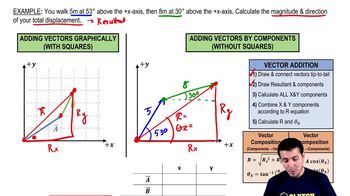
Vector Components

In physics, forces are represented as vectors, which have both magnitude and direction. To analyze a force acting at an angle, it can be broken down into its horizontal and vertical components using trigonometric functions. This allows for easier calculations of the effects of the force in each direction.
Recommended video:
Guided course
07:30
Vector Addition By Components

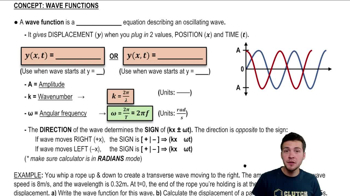
Trigonometric Functions

Trigonometric functions, such as sine and cosine, are essential for resolving vector components. For a force at an angle θ, the horizontal component can be found using the cosine function (F_horizontal = F * cos(θ)), while the vertical component uses the sine function (F_vertical = F * sin(θ)). These functions relate the angles of a right triangle to the ratios of its sides.
Recommended video:
Guided course
08:30
Intro to Wave Functions

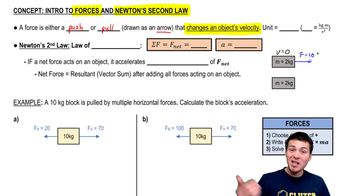
Newton's Second Law

Newton's Second Law states that the acceleration of an object is directly proportional to the net force acting on it and inversely proportional to its mass. While this question focuses on force components, understanding this law is crucial for analyzing how the applied forces affect the motion of the suitcase and Kami's overall movement.
Recommended video:
Guided course
06:54
Intro to Forces & Newton's Second Law
Related Practice
Textbook Question

Tom is climbing a 3.0-m-long ladder that leans against a vertical wall, contacting the wall 2.5 m above the ground. His weight of 680 N is a vector pointing vertically downward. (Weight is measured in newtons, abbreviated N.) What are the components of Tom's weight parallel and perpendicular to the ladder?

2
views
Textbook Question

A jet plane taking off from an aircraft carrier has acceleration a = ( 15 m/s², 22° above horizontal). What are the horizontal and vertical components of the jet's acceleration?

1
views
Textbook Question

Jack and Jill ran up the hill at 3.0 m/s. The horizontal component of Jill's velocity vector was 2.5 m/s. What was the vertical component of Jill's velocity?

1
views
Textbook Question

Jack and Jill ran up the hill at 3.0 m/s. The horizontal component of Jill's velocity vector was 2.5 m/s. What was the angle of the hill?

1
views
Textbook Question

Your neighbor Paul has rented a truck with a loading ramp. The ramp is tilted upward at 25°, and Paul is pulling a large crate up the ramp with a rope that angles 10° above the ramp. If Paul pulls with a force of 550 N, what are the horizontal and vertical components of his force? (Force is measured in newtons, abbreviated N.)

2
views
Textbook Question

You are fixing the roof of your house when a hammer breaks loose and slides down. The roof makes an angle of 35° with the horizontal, and the hammer is moving at 4.5 m/s when it reaches the edge. What are the horizontal and vertical components of the hammer's velocity just as it leaves the roof?

1
views