
Ch 03: Vectors and Coordinate Systems
Knight Calc - Physics for Scientists and Engineers 5th Edition
Knight Calc5th EditionPhysics for Scientists and EngineersISBN: 9780137344796Not the one you use?Change textbook
Chapter 3, Problem 39

Your neighbor Paul has rented a truck with a loading ramp. The ramp is tilted upward at 25°, and Paul is pulling a large crate up the ramp with a rope that angles 10° above the ramp. If Paul pulls with a force of 550 N, what are the horizontal and vertical components of his force? (Force is measured in newtons, abbreviated N.)

Verified step by step guidance
1
Step 1: Understand the problem. Paul is pulling a crate up a ramp with a force of 550 N. The rope is angled 10° above the ramp, and the ramp itself is tilted at 25°. We need to find the horizontal and vertical components of Paul's pulling force.
Step 2: Define the coordinate system. The horizontal direction is parallel to the ground, and the vertical direction is perpendicular to the ground. To find the components of the force, we need to resolve the force vector into these two directions.
Step 3: Calculate the total angle of the force relative to the horizontal. The ramp is tilted at 25°, and the rope is angled 10° above the ramp. Therefore, the total angle θ of the force relative to the horizontal is θ = 25° + 10° = 35°.
Step 4: Use trigonometric functions to resolve the force into components. The horizontal component of the force (F_x) is given by F_x = F * cos(θ), and the vertical component of the force (F_y) is given by F_y = F * sin(θ), where F = 550 N and θ = 35°.
Step 5: Substitute the values into the equations. For F_x, use F_x = 550 * cos(35°). For F_y, use F_y = 550 * sin(35°). These expressions give the horizontal and vertical components of Paul's pulling force.

Verified video answer for a similar problem:

This video solution was recommended by our tutors as helpful for the problem above.
Video duration:
7m
Was this helpful?

Key Concepts

Here are the essential concepts you must grasp in order to answer the question correctly.

Force Components

In physics, any force can be broken down into its horizontal and vertical components using trigonometric functions. The horizontal component is found by multiplying the force by the cosine of the angle, while the vertical component is determined by multiplying the force by the sine of the angle. This decomposition is essential for analyzing forces acting at angles, especially in problems involving inclined planes.
Recommended video:
Guided course
07:30
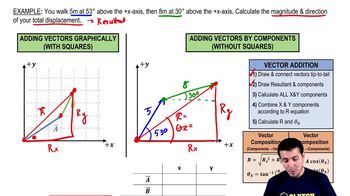
Vector Addition By Components

Inclined Plane

An inclined plane is a flat surface that is tilted at an angle to the horizontal. It is a simple machine that allows for the easier movement of objects by reducing the amount of force needed to lift them vertically. The angle of inclination affects the gravitational force acting on the object and the required force to move it up the ramp, making it crucial to consider in problems involving ramps.
Recommended video:
Guided course
06:59
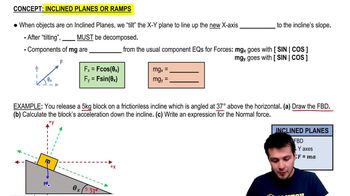
Intro to Inclined Planes

Trigonometric Functions

Trigonometric functions, such as sine and cosine, relate the angles of a triangle to the ratios of its sides. In the context of forces, these functions are used to resolve forces into their components based on the angle of application. Understanding how to apply these functions is vital for calculating the effects of forces acting at angles, particularly in scenarios involving ramps and inclined surfaces.
Recommended video:
Guided course
08:30
Intro to Wave Functions
Related Practice
Textbook Question

Tom is climbing a 3.0-m-long ladder that leans against a vertical wall, contacting the wall 2.5 m above the ground. His weight of 680 N is a vector pointing vertically downward. (Weight is measured in newtons, abbreviated N.) What are the components of Tom's weight parallel and perpendicular to the ladder?

2
views
Textbook Question

A jet plane taking off from an aircraft carrier has acceleration a = ( 15 m/s², 22° above horizontal). What are the horizontal and vertical components of the jet's acceleration?

1
views
Textbook Question

Jack and Jill ran up the hill at 3.0 m/s. The horizontal component of Jill's velocity vector was 2.5 m/s. What was the vertical component of Jill's velocity?

1
views
Textbook Question

Kami is walking through the airport with her two-wheeled suitcase. The suitcase handle is tilted 40° from vertical, and Kami pulls parallel to the handle with a force of 120 N. (Force is measured in newtons, abbreviated N.) What are the horizontal and vertical components of her applied force?

1
views
Textbook Question

The bacterium E. coli is a single-cell organism that lives in the gut of healthy animals, including humans. When grown in a uniform medium in the laboratory, these bacteria swim along zig-zag paths at a constant speed of 20 μm/s. FIGURE P3.42 shows the trajectory of an E. coli as it moves from point A to point E. What are the magnitude and direction of the bacterium's average velocity for the entire trip?

1
views
Textbook Question

The treasure map in FIGURE P3.41 gives the following directions to the buried treasure: 'Start at the old oak tree, walk due north for 500 paces, then due east for 100 paces. Dig.' But when you arrive, you find an angry dragon just north of the tree. To avoid the dragon, you set off along the yellow brick road at an angle 60° east of north. After walking 300 paces you see an opening through the woods. In which direction should you walk, as an angle west of north, and how far, to reach the treasure?

1
views