Ch 02: Kinematics in One Dimension
Knight Calc - Physics for Scientists and Engineers 5th Edition
Knight Calc5th EditionPhysics for Scientists and EngineersISBN: 9780137344796Not the one you use?Change textbook
Chapter 2, Problem 26

A car traveling at 30 m/s runs out of gas while traveling up a 10° slope. How far up the hill will it coast before starting to roll back down?

Verified step by step guidance
1
Step 1: Identify the forces acting on the car. The car is moving up a slope, so gravity will exert a force pulling it back down. The component of gravitational force along the slope is given by \( F_{gravity} = m g \sin \theta \), where \( m \) is the mass of the car, \( g \) is the acceleration due to gravity (9.8 m/s²), and \( \theta \) is the angle of the slope (10 degrees).
Step 2: Use the work-energy principle to analyze the motion. The car's initial kinetic energy \( KE = \frac{1}{2} m v^2 \), where \( v \) is the initial velocity (30 m/s), will be converted into gravitational potential energy \( PE = m g h \), where \( h \) is the height the car reaches. The car will stop when all its kinetic energy is converted into potential energy.
Step 3: Relate the height \( h \) to the distance \( d \) traveled along the slope using trigonometry. Since \( \sin \theta = \frac{h}{d} \), we can express \( h \) as \( h = d \sin \theta \). Substitute this into the energy equation to find \( d \).
Step 4: Set up the energy conservation equation: \( \frac{1}{2} m v^2 = m g d \sin \theta \). Notice that the mass \( m \) cancels out, simplifying the equation to \( \frac{1}{2} v^2 = g d \sin \theta \). Solve for \( d \): \( d = \frac{v^2}{2 g \sin \theta} \).
Step 5: Substitute the known values into the equation: \( v = 30 \, \text{m/s} \), \( g = 9.8 \, \text{m/s}^2 \), and \( \sin 10^\circ \). Perform the calculation to find the distance \( d \).

Verified video answer for a similar problem:

This video solution was recommended by our tutors as helpful for the problem above.
Video duration:
8m
Was this helpful?

Key Concepts

Here are the essential concepts you must grasp in order to answer the question correctly.

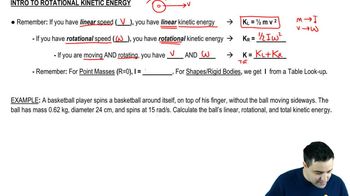
Kinetic Energy

Kinetic energy is the energy an object possesses due to its motion, calculated using the formula KE = 1/2 mv², where m is mass and v is velocity. In this scenario, the car's initial kinetic energy will determine how far it can coast up the slope before coming to a stop.
Recommended video:
Guided course
06:07
Intro to Rotational Kinetic Energy

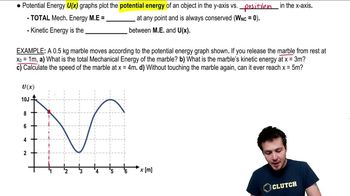
Potential Energy

Potential energy is the energy stored in an object due to its position in a gravitational field, given by PE = mgh, where m is mass, g is the acceleration due to gravity, and h is the height. As the car ascends the slope, its kinetic energy converts into potential energy until it reaches the maximum height.
Recommended video:
Guided course
07:24
Potential Energy Graphs

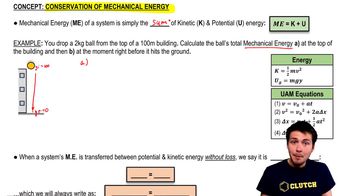
Conservation of Energy

The principle of conservation of energy states that energy cannot be created or destroyed, only transformed from one form to another. In this problem, the car's initial kinetic energy will be converted into gravitational potential energy as it coasts up the hill, allowing us to calculate the distance it travels before stopping.
Recommended video:
Guided course
06:24
Conservation Of Mechanical Energy