Ch 02: Kinematics in One Dimension
Knight Calc - Physics for Scientists and Engineers 5th Edition
Knight Calc5th EditionPhysics for Scientists and EngineersISBN: 9780137344796Not the one you use?Change textbook
Chapter 2, Problem 23

As a science project, you drop a watermelon off the top of the Empire State Building, 320 m above the sidewalk. It so happens that Superman flies by at the instant you release the watermelon. Superman is headed straight down with a speed of 35 m/s. How fast is the watermelon going when it passes Superman?

Verified step by step guidance
1
Identify the key variables: The initial height of the watermelon is 320 m, its initial velocity is 0 m/s (since it is dropped), and Superman's initial velocity is 35 m/s downward. The acceleration due to gravity is approximately 9.8 m/s².
Write the equation for the position of the watermelon as a function of time: y=yi0+vit+12gt², where vi is the initial velocity (0 m/s for the watermelon), g is the acceleration due to gravity, and t is time.
Write the equation for the position of Superman as a function of time: y=yi0+vit, where vi is Superman's initial velocity (35 m/s downward).
Set the two position equations equal to each other to find the time t when the watermelon passes Superman. Solve for t by equating the two equations and simplifying.
Once the time t is found, use the velocity equation for the watermelon: v=vi+gt. Substitute the value of t to calculate the velocity of the watermelon when it passes Superman.

Verified video answer for a similar problem:

This video solution was recommended by our tutors as helpful for the problem above.
Video duration:
12m
Was this helpful?

Key Concepts

Here are the essential concepts you must grasp in order to answer the question correctly.

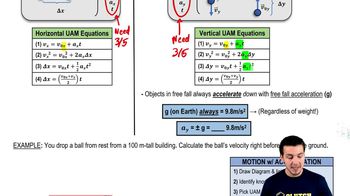
Free Fall

Free fall refers to the motion of an object under the influence of gravity alone, with no air resistance. In this scenario, the watermelon is in free fall after being dropped, meaning it accelerates downward at approximately 9.81 m/s², the acceleration due to gravity. This concept is crucial for determining the watermelon’s velocity at any point during its descent.
Recommended video:
Guided course
08:36
Vertical Motion & Free Fall

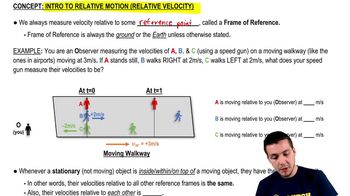
Relative Velocity

Relative velocity is the velocity of one object as observed from another object. In this case, we need to consider the speed of Superman as he descends at 35 m/s and compare it to the speed of the watermelon. Understanding relative velocity helps us determine how fast the watermelon is moving when it passes Superman, as we must account for both their speeds.
Recommended video:
Guided course
04:27
Intro to Relative Motion (Relative Velocity)

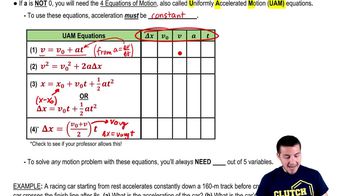
Kinematic Equations

Kinematic equations describe the motion of objects under constant acceleration. They can be used to calculate the final velocity of the watermelon just before it passes Superman. By applying the appropriate kinematic equation, we can find the watermelon’s speed after falling a certain distance, which is essential for solving the problem.
Recommended video:
Guided course
08:25
Kinematics Equations