Ch 02: Kinematics in One Dimension
Knight Calc - Physics for Scientists and Engineers 5th Edition
Knight Calc5th EditionPhysics for Scientists and EngineersISBN: 9780137344796Not the one you use?Change textbook
Chapter 2, Problem 21a

A rock is tossed straight up from ground level with a speed of 20 m/s. When it returns, it falls into a hole 10 m deep. What is the rock's speed as it hits the bottom of the hole?

Verified step by step guidance
1
Identify the known values: The initial velocity \( v_0 \) is 20 m/s (upward), the displacement \( s \) is -10 m (since the rock ends up 10 m below the starting point), and the acceleration due to gravity \( a \) is -9.8 m/s² (negative because it acts downward).
Use the kinematic equation \( v^2 = v_0^2 + 2as \) to find the final velocity \( v \) of the rock when it hits the bottom of the hole. Here, \( v_0 \) is the initial velocity, \( a \) is the acceleration, and \( s \) is the displacement.
Substitute the known values into the equation: \( v^2 = (20)^2 + 2(-9.8)(-10) \). Simplify the terms inside the equation to prepare for solving for \( v \).
Take the square root of both sides of the equation to solve for \( v \): \( v = \sqrt{v^2} \). Remember that the final velocity will be positive because we are looking for the magnitude of the speed as it hits the bottom of the hole.
Interpret the result: The calculated \( v \) represents the speed of the rock just before it hits the bottom of the hole. Ensure the units are consistent (m/s) and verify the calculation aligns with the physical scenario.

Verified video answer for a similar problem:

This video solution was recommended by our tutors as helpful for the problem above.
Video duration:
5m
Was this helpful?

Key Concepts

Here are the essential concepts you must grasp in order to answer the question correctly.

Kinematics

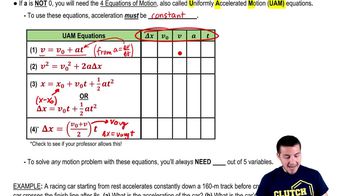
Kinematics is the branch of physics that describes the motion of objects without considering the forces that cause the motion. It involves concepts such as displacement, velocity, acceleration, and time. In this problem, kinematic equations can be used to relate the initial speed of the rock, the height it reaches, and its final speed when it hits the bottom of the hole.
Recommended video:
Guided course
08:25
Kinematics Equations

Conservation of Energy

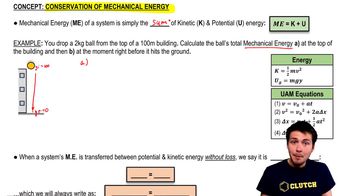
The principle of conservation of energy states that energy cannot be created or destroyed, only transformed from one form to another. In this scenario, the rock's initial kinetic energy when tossed upwards is converted into gravitational potential energy at its highest point and then back into kinetic energy as it falls. This principle helps in calculating the speed of the rock just before it impacts the bottom of the hole.
Recommended video:
Guided course
06:24
Conservation Of Mechanical Energy

Gravitational Potential Energy

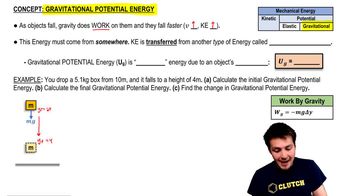
Gravitational potential energy (GPE) is the energy an object possesses due to its position in a gravitational field, calculated as GPE = mgh, where m is mass, g is the acceleration due to gravity, and h is height. In this problem, the rock's potential energy at the peak of its trajectory and the depth of the hole are crucial for determining its speed upon impact, as the energy lost in potential energy translates into kinetic energy.
Recommended video:
Guided course
06:35
Gravitational Potential Energy