Ch 02: Kinematics in One Dimension
Knight Calc - Physics for Scientists and Engineers 5th Edition
Knight Calc5th EditionPhysics for Scientists and EngineersISBN: 9780137344796Not the one you use?Change textbook
Chapter 2, Problem 27a

A skier is gliding along at 3.0 m/s on horizontal, frictionless snow. He suddenly starts down a 10° incline. His speed at the bottom is 15 m/s. What is the length of the incline?

Verified step by step guidance
1
Identify the known quantities: initial velocity \( v_i = 3.0 \; \text{m/s} \), final velocity \( v_f = 15.0 \; \text{m/s} \), and the angle of the incline \( \theta = 10^\circ \). The goal is to find the length of the incline \( d \).
Use the work-energy principle, which states that the change in kinetic energy is equal to the work done by gravity. The equation is \( \Delta KE = W_g \), where \( \Delta KE = \frac{1}{2} m v_f^2 - \frac{1}{2} m v_i^2 \) and \( W_g = m g d \sin(\theta) \).
Cancel out the mass \( m \) from both sides of the equation since it appears in every term. This simplifies to \( \frac{1}{2} v_f^2 - \frac{1}{2} v_i^2 = g d \sin(\theta) \).
Rearrange the equation to solve for \( d \): \( d = \frac{v_f^2 - v_i^2}{2 g \sin(\theta)} \).
Substitute the known values into the equation: \( v_f = 15.0 \; \text{m/s} \), \( v_i = 3.0 \; \text{m/s} \), \( g = 9.8 \; \text{m/s}^2 \), and \( \sin(10^\circ) \). Perform the calculations to find \( d \).

Verified video answer for a similar problem:

This video solution was recommended by our tutors as helpful for the problem above.
Video duration:
7m
Was this helpful?

Key Concepts

Here are the essential concepts you must grasp in order to answer the question correctly.

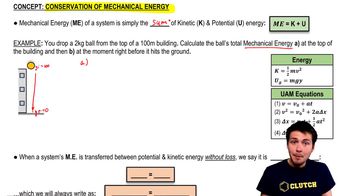
Conservation of Energy

The principle of conservation of energy states that in a closed system, the total energy remains constant. In this scenario, the skier's initial kinetic energy and potential energy at the top of the incline will convert into kinetic energy at the bottom. This concept is crucial for determining the relationship between the skier's speeds and the height of the incline.
Recommended video:
Guided course
06:24
Conservation Of Mechanical Energy

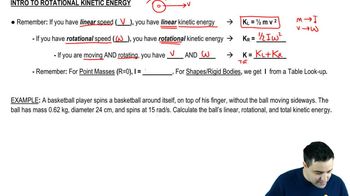
Kinetic Energy

Kinetic energy is the energy an object possesses due to its motion, calculated using the formula KE = 1/2 mv², where m is mass and v is velocity. In this problem, the skier's speed changes from 3.0 m/s to 15 m/s, indicating a change in kinetic energy as he descends the incline, which is essential for calculating the length of the incline.
Recommended video:
Guided course
06:07
Intro to Rotational Kinetic Energy

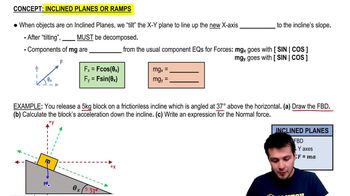
Inclined Plane Dynamics

Inclined plane dynamics involves analyzing the motion of objects on slopes, taking into account gravitational forces and angles. The angle of the incline affects the component of gravitational force acting along the slope, which influences the skier's acceleration. Understanding this concept helps in determining the length of the incline based on the skier's change in speed.
Recommended video:
Guided course
06:59
Intro to Inclined Planes