Ch 02: Kinematics in One Dimension
Knight Calc - Physics for Scientists and Engineers 5th Edition
Knight Calc5th EditionPhysics for Scientists and EngineersISBN: 9780137344796Not the one you use?Change textbook
Chapter 2, Problem 29

A bicycle coasting at 8.0 m/s comes to a 5.0-m-long, 1.0-m-high ramp. What is the bicycle's speed as it leaves the top of the ramp?

Verified step by step guidance
1
Step 1: Identify the type of energy transformation occurring in the problem. The bicycle's initial kinetic energy is partially converted into gravitational potential energy as it climbs the ramp. Use the principle of conservation of mechanical energy to solve the problem.
Step 2: Write the equation for conservation of mechanical energy: \( KE_{initial} + PE_{initial} = KE_{final} + PE_{final} \). Here, \( KE \) represents kinetic energy \( \frac{1}{2}mv^2 \), and \( PE \) represents gravitational potential energy \( mgh \).
Step 3: Simplify the equation by noting that \( PE_{initial} \) is zero because the ramp starts at ground level. The equation becomes \( \frac{1}{2}mv_{initial}^2 = \frac{1}{2}mv_{final}^2 + mgh \). Cancel out the mass \( m \) from all terms since it appears in every term.
Step 4: Rearrange the equation to solve for \( v_{final} \), the speed of the bicycle at the top of the ramp: \( v_{final} = \sqrt{v_{initial}^2 - 2gh} \). Substitute the given values: \( v_{initial} = 8.0 \ \text{m/s} \), \( g = 9.8 \ \text{m/s}^2 \), and \( h = 1.0 \ \text{m} \).
Step 5: Perform the substitution and simplify the expression for \( v_{final} \). This will give the bicycle's speed as it leaves the top of the ramp. Ensure units are consistent throughout the calculation.

Verified video answer for a similar problem:

This video solution was recommended by our tutors as helpful for the problem above.
Video duration:
7m
Was this helpful?

Key Concepts

Here are the essential concepts you must grasp in order to answer the question correctly.

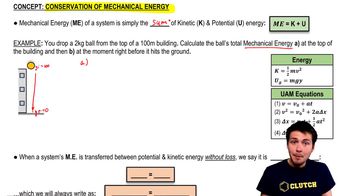
Conservation of Energy

The principle of conservation of energy states that in a closed system, the total energy remains constant. In this scenario, the bicycle's initial kinetic energy will be converted into potential energy as it climbs the ramp, and then back into kinetic energy as it descends. This concept is crucial for determining the speed of the bicycle at the top of the ramp.
Recommended video:
Guided course
06:24
Conservation Of Mechanical Energy

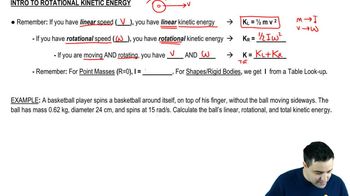
Kinetic Energy

Kinetic energy is the energy an object possesses due to its motion, calculated using the formula KE = 1/2 mv², where m is mass and v is velocity. As the bicycle coasts up the ramp, its kinetic energy decreases as it converts to potential energy. Understanding this relationship is essential for solving the problem.
Recommended video:
Guided course
06:07
Intro to Rotational Kinetic Energy

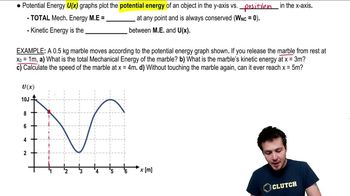
Potential Energy

Potential energy is the stored energy of an object due to its position in a gravitational field, calculated using the formula PE = mgh, where m is mass, g is the acceleration due to gravity, and h is height. As the bicycle ascends the ramp, it gains potential energy, which affects its speed at the top. This concept is vital for analyzing the energy transformations involved.
Recommended video:
Guided course
07:24
Potential Energy Graphs