Ch 19: Work, Heat, and the First Law of Thermodynamics
Knight Calc - Physics for Scientists and Engineers 5th Edition
Knight Calc5th EditionPhysics for Scientists and EngineersISBN: 9780137344796Not the one you use?Change textbook
Chapter 19, Problem 25

10 g of steam at the boiling point are combined with 50 g of ice at the freezing point. What is the final temperature of the system?

Verified step by step guidance
1
Step 1: Identify the key concepts involved in the problem. This problem involves phase changes (condensation of steam and melting of ice) and heat transfer. The steam will release heat as it condenses and cools, while the ice will absorb heat as it melts and warms. The final temperature will depend on the balance of heat transfer.
Step 2: Write the heat transfer equations for each phase change and temperature change. For the steam: the heat released during condensation is given by \( Q_{condensation} = m_{steam} \cdot L_{v} \), where \( L_{v} \) is the latent heat of vaporization. If the steam cools further, the heat released is \( Q_{cooling} = m_{steam} \cdot c_{water} \cdot \Delta T \). For the ice: the heat absorbed during melting is \( Q_{melting} = m_{ice} \cdot L_{f} \), where \( L_{f} \) is the latent heat of fusion. If the melted ice warms further, the heat absorbed is \( Q_{warming} = m_{water} \cdot c_{water} \cdot \Delta T \).
Step 3: Set up the heat balance equation. The heat released by the steam must equal the heat absorbed by the ice and water. This can be expressed as \( Q_{condensation} + Q_{cooling} = Q_{melting} + Q_{warming} \). Substitute the expressions for \( Q_{condensation} \), \( Q_{cooling} \), \( Q_{melting} \), and \( Q_{warming} \) into this equation.
Step 4: Solve for the final temperature \( T_{final} \). Depending on the amount of heat released and absorbed, the final temperature may be above freezing (if all the ice melts and the water warms) or at freezing (if not all the ice melts). Use the heat balance equation to determine \( T_{final} \).
Step 5: Check the conditions for phase changes. Ensure that the heat released by the steam is sufficient to melt all the ice and warm the resulting water. If not, adjust the calculations to account for partial melting or cooling of the steam. Use the specific values for \( L_{v} \), \( L_{f} \), and \( c_{water} \) to complete the calculations.

Verified video answer for a similar problem:

This video solution was recommended by our tutors as helpful for the problem above.
Video duration:
7m
Was this helpful?

Key Concepts

Here are the essential concepts you must grasp in order to answer the question correctly.

Phase Change

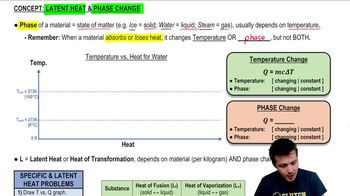
Phase change refers to the transition of matter from one state to another, such as from solid to liquid (melting) or liquid to gas (vaporization). In this problem, steam (gas) condenses to water (liquid) while ice (solid) melts to water, both processes involving energy transfer without a change in temperature until the phase change is complete.
Recommended video:
Guided course
10:40
Latent Heat & Phase Changes

Heat Transfer

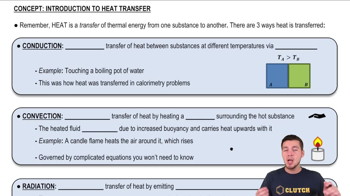
Heat transfer is the process of thermal energy moving from one object or substance to another due to a temperature difference. In this scenario, heat will flow from the steam to the ice, causing the steam to cool and condense while the ice warms and melts, ultimately reaching thermal equilibrium at a final temperature.
Recommended video:
Guided course
05:14
Overview of Heat Transfer

Specific Heat Capacity

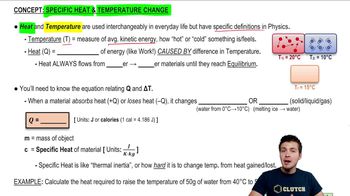
Specific heat capacity is the amount of heat required to raise the temperature of a unit mass of a substance by one degree Celsius. This concept is crucial for calculating the energy changes involved in heating or cooling the water formed from the steam and ice, as different phases of water (ice, liquid water, steam) have different specific heat capacities.
Recommended video:
Guided course
06:50
Specific Heat & Temperature Changes