Ch 19: Work, Heat, and the First Law of Thermodynamics
Knight Calc - Physics for Scientists and Engineers 5th Edition
Knight Calc5th EditionPhysics for Scientists and EngineersISBN: 9780137344796Not the one you use?Change textbook
Chapter 19, Problem 28a

A container holds 1.0 g of oxygen at a pressure of 8.0 atm. How much heat is required to increase the temperature by 100°C at constant pressure?

Verified step by step guidance
1
Step 1: Identify the relevant formula for heat transfer at constant pressure. The heat required can be calculated using the formula: Q=nCpT, where Q is the heat, n is the number of moles, Cp is the molar heat capacity at constant pressure, and T is the temperature change.
Step 2: Calculate the number of moles of oxygen gas. Use the molar mass of oxygen, which is approximately 32 g/mol. The number of moles is given by n=mM, where m is the mass of the gas (1.0 g) and M is the molar mass (32 g/mol).
Step 3: Look up the molar heat capacity at constant pressure for oxygen gas. For diatomic gases like oxygen, Cp is approximately 29 J/(mol·K).
Step 4: Determine the temperature change in Kelvin. Since the problem specifies a temperature increase of 100°C, and the size of a degree is the same in Celsius and Kelvin, the temperature change is T=100 K.
Step 5: Substitute the values into the formula Q=nCpT. Use the calculated number of moles, the molar heat capacity, and the temperature change to find the heat required. Ensure the units are consistent throughout the calculation.

Verified video answer for a similar problem:

This video solution was recommended by our tutors as helpful for the problem above.
Was this helpful?

Key Concepts

Here are the essential concepts you must grasp in order to answer the question correctly.

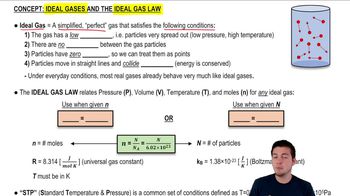
Ideal Gas Law

The Ideal Gas Law relates the pressure, volume, temperature, and number of moles of a gas through the equation PV = nRT. This law is essential for understanding how gases behave under different conditions, particularly when changes in temperature and pressure occur. In this question, it helps to establish the relationship between the gas's properties as heat is added.
Recommended video:
Guided course
07:21
Ideal Gases and the Ideal Gas Law

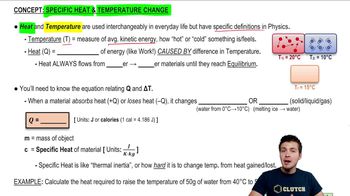
Specific Heat Capacity

Specific heat capacity is the amount of heat required to raise the temperature of a unit mass of a substance by one degree Celsius. For gases, this value can vary depending on whether the process occurs at constant pressure or volume. In this scenario, the specific heat capacity at constant pressure (Cp) is crucial for calculating the heat required to achieve the desired temperature increase.
Recommended video:
Guided course
06:50
Specific Heat & Temperature Changes

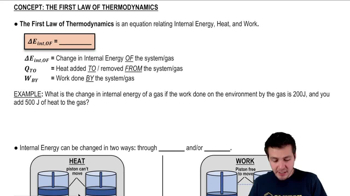
First Law of Thermodynamics

The First Law of Thermodynamics states that energy cannot be created or destroyed, only transformed. In the context of this question, it implies that the heat added to the gas will result in a change in internal energy and work done by the gas, particularly since the process occurs at constant pressure. Understanding this principle is vital for calculating the heat transfer involved in the temperature change.
Recommended video:
Guided course
08:04
The First Law of Thermodynamics