Ch 19: Work, Heat, and the First Law of Thermodynamics
Knight Calc - Physics for Scientists and Engineers 5th Edition
Knight Calc5th EditionPhysics for Scientists and EngineersISBN: 9780137344796Not the one you use?Change textbook
Chapter 19, Problem 24

A 65 cm3 block of iron is removed from an 800°C furnace and immediately dropped into 200 mL of 20°C water. What fraction of the water boils away?

Verified step by step guidance
1
Convert the given volumes into masses. For the iron block, use the density of iron (approximately 7.87 g/cm³) to calculate its mass. For water, use the density of water (1 g/mL) to determine its mass.
Calculate the heat lost by the iron block as it cools from 800°C to 100°C (the boiling point of water). Use the formula for heat transfer: Q = mcΔT, where m is the mass of the iron, c is the specific heat capacity of iron (approximately 0.45 J/g°C), and ΔT is the temperature change.
Determine the heat required to raise the water from 20°C to 100°C using the same heat transfer formula: Q = mcΔT, where c is the specific heat capacity of water (4.18 J/g°C).
Calculate the heat required to boil the water at 100°C using the formula: Q = mL, where L is the latent heat of vaporization of water (2260 J/g).
Compare the heat lost by the iron block to the total heat required to raise the water to 100°C and boil it. The fraction of water that boils away is the ratio of the heat available for vaporization to the heat required for vaporizing the entire mass of water.

Verified video answer for a similar problem:

This video solution was recommended by our tutors as helpful for the problem above.
Video duration:
6m
Was this helpful?

Key Concepts

Here are the essential concepts you must grasp in order to answer the question correctly.

Heat Transfer

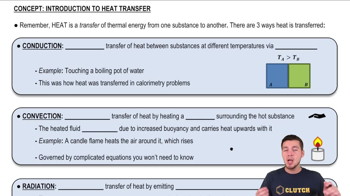
Heat transfer is the process by which thermal energy moves from one object to another due to a temperature difference. In this scenario, the hot iron block will transfer heat to the cooler water until thermal equilibrium is reached. Understanding the mechanisms of conduction, convection, and radiation is essential for analyzing how heat moves between the iron and water.
Recommended video:
Guided course
05:14
Overview of Heat Transfer

Specific Heat Capacity

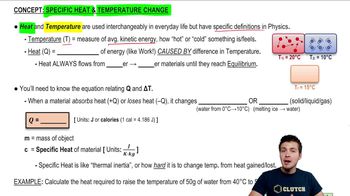
Specific heat capacity is the amount of heat required to raise the temperature of a unit mass of a substance by one degree Celsius. Each material has a unique specific heat capacity, which influences how much heat it can absorb or release. In this problem, knowing the specific heat capacities of both iron and water is crucial for calculating the temperature change and the resulting heat transfer.
Recommended video:
Guided course
06:50
Specific Heat & Temperature Changes

Phase Change and Latent Heat

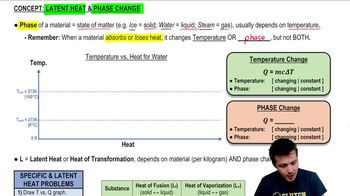
Phase change refers to the transition of a substance from one state of matter to another, such as from liquid to gas. During this process, energy is absorbed or released without a change in temperature, known as latent heat. In this question, understanding the latent heat of vaporization for water is vital to determine how much water can boil away as it absorbs heat from the iron block.
Recommended video:
Guided course
10:40
Latent Heat & Phase Changes