
Ch 19: Work, Heat, and the First Law of Thermodynamics
Knight Calc - Physics for Scientists and Engineers 5th Edition
Knight Calc5th EditionPhysics for Scientists and EngineersISBN: 9780137344796Not the one you use?Change textbook
Chapter 19, Problem 22

30 g of copper pellets are removed from a 300°C oven and immediately dropped into 100 mL of water at 20°C in an insulated cup. What will the new water temperature be?

Verified step by step guidance
1
Identify the principle of conservation of energy: The heat lost by the copper pellets will be equal to the heat gained by the water, assuming no heat is lost to the surroundings (since the system is insulated).
Write the heat transfer equations for both substances. For copper: \( Q_{\text{copper}} = m_{\text{copper}} c_{\text{copper}} \Delta T_{\text{copper}} \), and for water: \( Q_{\text{water}} = m_{\text{water}} c_{\text{water}} \Delta T_{\text{water}} \).
Set the heat lost by copper equal to the heat gained by water: \( m_{\text{copper}} c_{\text{copper}} (T_{\text{initial, copper}} - T_{\text{final}}) = m_{\text{water}} c_{\text{water}} (T_{\text{final}} - T_{\text{initial, water}}) \).
Substitute the known values into the equation: \( m_{\text{copper}} = 0.03 \; \text{kg}, \; c_{\text{copper}} = 385 \; \text{J/kg°C}, \; T_{\text{initial, copper}} = 300 \; \text{°C}, \; m_{\text{water}} = 0.1 \; \text{kg}, \; c_{\text{water}} = 4186 \; \text{J/kg°C}, \; T_{\text{initial, water}} = 20 \; \text{°C} \).
Solve the equation for \( T_{\text{final}} \), the final equilibrium temperature, by isolating it algebraically and performing the necessary calculations.

Verified video answer for a similar problem:

This video solution was recommended by our tutors as helpful for the problem above.
Video duration:
5m
Was this helpful?

Key Concepts

Here are the essential concepts you must grasp in order to answer the question correctly.

Heat Transfer

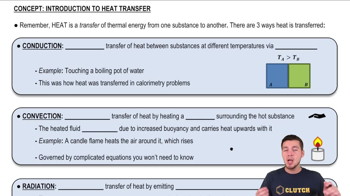
Heat transfer is the process by which thermal energy moves from one object to another due to a temperature difference. In this scenario, heat will flow from the hot copper pellets to the cooler water until thermal equilibrium is reached, meaning both substances will eventually stabilize at the same temperature.
Recommended video:
Guided course
05:14
Overview of Heat Transfer

Specific Heat Capacity

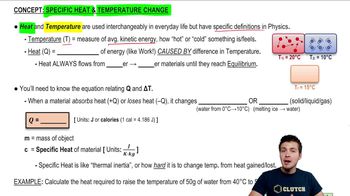
Specific heat capacity is the amount of heat required to raise the temperature of a unit mass of a substance by one degree Celsius. Each material has a unique specific heat capacity, which influences how much its temperature changes when heat is added or removed. For this problem, the specific heat capacities of copper and water will be crucial in calculating the final temperature.
Recommended video:
Guided course
06:50
Specific Heat & Temperature Changes

Conservation of Energy

The principle of conservation of energy states that energy cannot be created or destroyed, only transformed from one form to another. In this context, the heat lost by the copper pellets will equal the heat gained by the water, allowing us to set up an equation to find the final temperature of the water after the copper is added.
Recommended video:
Guided course
06:24
Conservation Of Mechanical Energy