Textbook Question
What is the maximum mass of ethyl alcohol you could boil with 1000 J of heat, starting from 20°C?
1
views

 Knight Calc 5th EditionCh 19: Work, Heat, and the First Law of ThermodynamicsProblem 19a
 Verified step by step guidance
 06:07
06:07
 06:24
06:24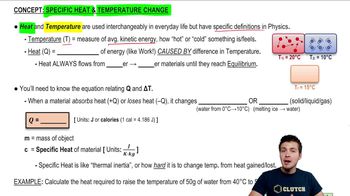 06:50
06:50What is the maximum mass of ethyl alcohol you could boil with 1000 J of heat, starting from 20°C?
How much heat energy must be added to a 6.0-cm-diameter copper sphere to raise its temperature from −50°C to 150°C?
30 g of copper pellets are removed from a 300°C oven and immediately dropped into 100 mL of water at 20°C in an insulated cup. What will the new water temperature be?
One way you keep from overheating is by perspiring. Evaporation—a phase change—requires heat, and the heat energy is removed from your body. Evaporation is much like boiling, only water's heat of vaporization at 35°C is a somewhat larger 24×105 J/kg because at lower temperatures more energy is required to break the molecular bonds. Very strenuous activity can cause an adult human to produce 30 g of perspiration per minute. If all the perspiration evaporates, rather than dripping off, at what rate (in J/s) is it possible to exhaust heat by perspiring?
An experiment measures the temperature of a 500 g substance while steadily supplying heat to it. FIGURE EX19.20 shows the results of the experiment. What are the heats of fusion and vaporization?
A 750 g aluminum pan is removed from the stove and plunged into a sink filled with 10.0 L of water at 20.0°C . The water temperature quickly rises to 24.0°C. What was the initial temperature of the pan in °C and in °F?