The volume of a gas is halved during an adiabatic compression that increases the pressure by a factor of 2.5. What is the specific heat ratio γ?
Ch 19: Work, Heat, and the First Law of Thermodynamics
Knight Calc5th EditionPhysics for Scientists and EngineersISBN: 9780137344796Not the one you use?Change textbook
All textbooks
Knight Calc 5th Edition
Ch 19: Work, Heat, and the First Law of Thermodynamics
Problem 28b
Knight Calc 5th Edition
Ch 19: Work, Heat, and the First Law of Thermodynamics
Problem 28bChapter 19, Problem 28b
A container holds 1.0 g of oxygen at a pressure of 8.0 atm. How much will the temperature increase if this amount of heat energy is transferred to the gas at constant volume?
Verified step by step guidance1
Step 1: Identify the given values and the formula to use. The problem involves heat transfer at constant volume, so we use the formula for heat transfer in an ideal gas: , where is the heat energy transferred, is the number of moles of gas, is the molar heat capacity at constant volume, and is the temperature change.
Step 2: Calculate the number of moles of oxygen gas. Use the molar mass of oxygen, which is approximately 32 g/mol. The number of moles is given by , where is the mass of the gas (1.0 g) and is the molar mass.
Step 3: Determine the molar heat capacity at constant volume, . For diatomic gases like oxygen, is approximately , where is the universal gas constant (8.314 J/(mol·K)).
Step 4: Rearrange the heat transfer formula to solve for the temperature change: . Substitute the values of , , and into the equation.
Step 5: Perform the calculation to find . This will give the increase in temperature of the gas in Kelvin. Ensure the units are consistent throughout the calculation.

Verified video answer for a similar problem:
This video solution was recommended by our tutors as helpful for the problem above.
Was this helpful?
Key Concepts
Here are the essential concepts you must grasp in order to answer the question correctly.
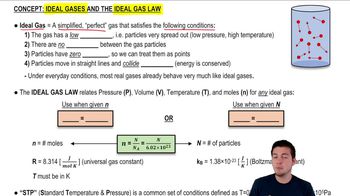
Ideal Gas Law
The Ideal Gas Law relates the pressure, volume, temperature, and number of moles of a gas through the equation PV = nRT. This law is fundamental in understanding how gases behave under various conditions, particularly when analyzing changes in temperature and pressure while keeping volume constant.
Recommended video:
Guided course
Ideal Gases and the Ideal Gas Law
Heat Transfer and Internal Energy
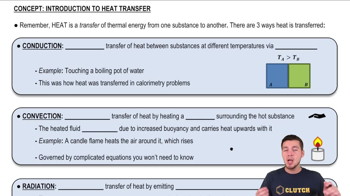
Heat transfer refers to the energy exchanged between a system and its surroundings due to a temperature difference. In the context of gases, when heat is added at constant volume, it increases the internal energy of the gas, which is directly related to its temperature, as described by the first law of thermodynamics.
Recommended video:
Guided course
Overview of Heat Transfer
Specific Heat Capacity
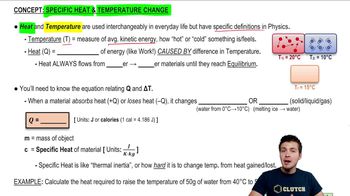
Specific heat capacity is the amount of heat required to raise the temperature of a unit mass of a substance by one degree Celsius. For gases, this concept is crucial when calculating temperature changes resulting from heat transfer, as it determines how much the temperature will increase based on the amount of heat added.
Recommended video:
Guided course
Specific Heat & Temperature Changes
Related Practice
Textbook Question
2
views
Textbook Question
A gas cylinder holds 0.10 mol of O₂ at 150°C and a pressure of 3.0 atm. The gas expands adiabatically until the pressure is halved. What are the final volume?
Textbook Question
A container holds 1.0 g of oxygen at a pressure of 8.0 atm. How much heat is required to increase the temperature by 100°C at constant pressure?
Textbook Question
A monatomic gas follows the process 1→2→3 shown in FIGURE EX19.26. How much heat is needed for (a) process 1→2 and (b) process 2→3?
Textbook Question
10 g of steam at the boiling point are combined with 50 g of ice at the freezing point. What is the final temperature of the system?
1
views
Textbook Question
A gas cylinder holds 0.10 mol of O₂ at 150°C and a pressure of 3.0 atm. The gas expands adiabatically until the pressure is halved. What are the final temperature?
2
views