Ch 06: Dynamics I: Motion Along a Line
Knight Calc - Physics for Scientists and Engineers 5th Edition
Knight Calc5th EditionPhysics for Scientists and EngineersISBN: 9780137344796Not the one you use?Change textbook
Chapter 6, Problem 27

Bob is pulling a 30 kg filing cabinet with a force of 200 N, but the filing cabinet refuses to move. The coefficient of static friction between the filing cabinet and the floor is 0.80. What is the magnitude of the friction force on the filing cabinet?

Verified step by step guidance
1
Step 1: Begin by identifying the forces acting on the filing cabinet. The force applied by Bob is 200 N, and the force of static friction opposes this applied force. The static friction force depends on the normal force and the coefficient of static friction.
Step 2: Calculate the normal force acting on the filing cabinet. The normal force is equal to the weight of the cabinet, which can be found using the equation: Fn = mg, where m is the mass of the cabinet (30 kg) and g is the acceleration due to gravity (approximately 9.8 m/s²).
Step 3: Use the coefficient of static friction to calculate the maximum static friction force. The formula is: Ff,max = μsFn, where μs is the coefficient of static friction (0.80) and Fn is the normal force calculated in Step 2.
Step 4: Compare the applied force (200 N) to the maximum static friction force calculated in Step 3. If the applied force is less than or equal to the maximum static friction force, the filing cabinet will not move, and the friction force will equal the applied force. If the applied force exceeds the maximum static friction force, the cabinet will begin to move, and kinetic friction would need to be considered.
Step 5: Conclude that since the filing cabinet does not move, the friction force acting on the cabinet is equal to the applied force of 200 N. This is because the static friction force adjusts to match the applied force up to its maximum limit.

Verified video answer for a similar problem:

This video solution was recommended by our tutors as helpful for the problem above.
Video duration:
3m
Was this helpful?

Key Concepts

Here are the essential concepts you must grasp in order to answer the question correctly.

Static Friction

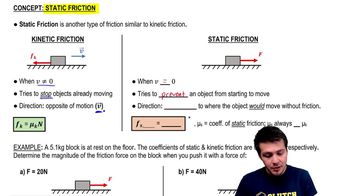
Static friction is the force that resists the initiation of sliding motion between two surfaces in contact. It acts in the opposite direction to the applied force and varies in magnitude up to a maximum value, which is determined by the coefficient of static friction and the normal force. In this scenario, the static friction force must be overcome for the filing cabinet to start moving.
Recommended video:
Guided course
08:11
Static Friction & Equilibrium

Coefficient of Static Friction

The coefficient of static friction (μs) is a dimensionless value that represents the ratio of the maximum static friction force to the normal force acting between two surfaces. It quantifies how much force is needed to initiate movement. For the filing cabinet, with a coefficient of 0.80, this means that the static friction force can be calculated by multiplying this coefficient by the normal force, which is equal to the weight of the cabinet.
Recommended video:
Guided course
08:11
Static Friction & Equilibrium

Normal Force

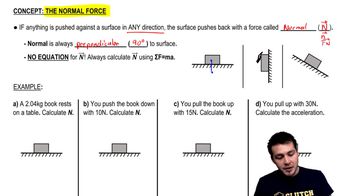
The normal force is the perpendicular force exerted by a surface to support the weight of an object resting on it. It acts in opposition to gravity and is crucial for calculating frictional forces. In this case, the normal force on the filing cabinet is equal to its weight, which can be calculated by multiplying its mass (30 kg) by the acceleration due to gravity (approximately 9.81 m/s²).
Recommended video:
Guided course
08:17
The Normal Force