Ch 06: Dynamics I: Motion Along a Line
Knight Calc - Physics for Scientists and Engineers 5th Edition
Knight Calc5th EditionPhysics for Scientists and EngineersISBN: 9780137344796Not the one you use?Change textbook
Chapter 6, Problem 25

Bonnie and Clyde are sliding a 300 kg bank safe across the floor to their getaway car. The safe slides with a constant speed if Clyde pushes from behind with 385 N of force while Bonnie pulls forward on a rope with 350 N of force. What is the safe's coefficient of kinetic friction on the bank floor?

Verified step by step guidance
1
Step 1: Identify the forces acting on the safe. Clyde applies a force of 385 N from behind, Bonnie applies a pulling force of 350 N forward, and the force of kinetic friction opposes their combined efforts. Since the safe moves at a constant speed, the net force is zero, meaning the applied forces are balanced by the frictional force.
Step 2: Calculate the total applied force. Add Clyde's force and Bonnie's force together: \( F_{\text{applied}} = 385 \text{ N} + 350 \text{ N} \). This gives the total force exerted to overcome friction.
Step 3: Use the relationship between the frictional force and the coefficient of kinetic friction. The frictional force \( F_{\text{friction}} \) is given by \( F_{\text{friction}} = \mu_k \cdot F_{\text{normal}} \), where \( \mu_k \) is the coefficient of kinetic friction and \( F_{\text{normal}} \) is the normal force.
Step 4: Determine the normal force. Since the safe is sliding horizontally, the normal force is equal to the gravitational force acting on the safe: \( F_{\text{normal}} = m \cdot g \), where \( m = 300 \text{ kg} \) is the mass of the safe and \( g = 9.8 \text{ m/s}^2 \) is the acceleration due to gravity.
Step 5: Solve for the coefficient of kinetic friction \( \mu_k \). Rearrange the frictional force equation to \( \mu_k = \frac{F_{\text{friction}}}{F_{\text{normal}}} \). Substitute \( F_{\text{friction}} = F_{\text{applied}} \) and \( F_{\text{normal}} = m \cdot g \) into the equation to find \( \mu_k \).

Verified video answer for a similar problem:

This video solution was recommended by our tutors as helpful for the problem above.
Video duration:
5m
Was this helpful?

Key Concepts

Here are the essential concepts you must grasp in order to answer the question correctly.

Newton's Second Law of Motion

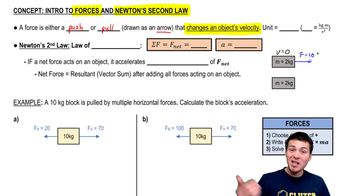
Newton's Second Law states that the acceleration of an object is directly proportional to the net force acting on it and inversely proportional to its mass. In this scenario, since the safe moves at a constant speed, the net force acting on it is zero, indicating that the forces applied by Clyde and Bonnie are balanced by the frictional force opposing the motion.
Recommended video:
Guided course
06:54
Intro to Forces & Newton's Second Law

Friction

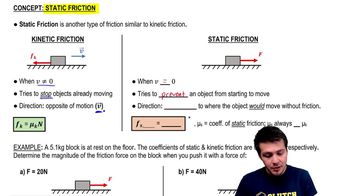
Friction is the force that opposes the relative motion of two surfaces in contact. The coefficient of kinetic friction is a dimensionless value that represents the ratio of the frictional force resisting the motion to the normal force acting on the object. In this case, it helps determine how much force is needed to keep the safe sliding at a constant speed.
Recommended video:
Guided course
08:11
Static Friction & Equilibrium

Coefficient of Kinetic Friction

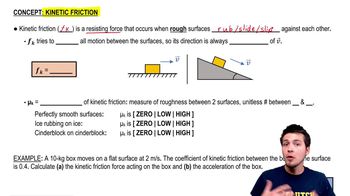
The coefficient of kinetic friction (μk) quantifies the frictional force between two moving surfaces. It is calculated using the formula: μk = F_friction / F_normal, where F_friction is the force of friction and F_normal is the normal force. In this problem, it can be derived from the forces applied by Clyde and Bonnie and the weight of the safe.
Recommended video:
Guided course
06:18
Kinetic Friction Problems