Ch 06: Dynamics I: Motion Along a Line
Knight Calc - Physics for Scientists and Engineers 5th Edition
Knight Calc5th EditionPhysics for Scientists and EngineersISBN: 9780137344796Not the one you use?Change textbook
Chapter 6, Problem 26b

A 10 kg crate is placed on a horizontal conveyor belt. The materials are such that μs\(\mu\)_{s} = 0.5 and μk\(\mu\)_{k} = 0.3. Draw a free-body diagram showing all the forces on the crate if the conveyer belt is speeding up.

Verified step by step guidance
1
Start by identifying all the forces acting on the crate. These include the gravitational force (weight), the normal force, the frictional force, and any applied force due to the conveyor belt's motion.
Draw the free-body diagram. Represent the crate as a point or a small box. Draw a downward arrow labeled as the gravitational force \( F_g = m \cdot g \), where \( m = 10 \ \text{kg} \) and \( g = 9.8 \ \text{m/s}^2 \).
Draw an upward arrow of equal length to the gravitational force, labeled as the normal force \( F_N \). This force is exerted by the conveyor belt and balances the weight of the crate in the vertical direction.
Since the conveyor belt is speeding up, there is a tendency for the crate to resist this motion due to inertia. The frictional force acts to oppose this relative motion. Draw a horizontal arrow pointing in the direction of the conveyor belt's motion, labeled as the static frictional force \( F_{\text{friction}} \). The maximum static friction is given by \( F_{\text{friction}} = \mu_s \cdot F_N \), where \( \mu_s = 0.5 \).
Finally, ensure that the diagram is complete and consistent. Verify that all forces are labeled correctly and that the directions of the forces align with the physical situation described (e.g., friction opposes relative motion, normal force is perpendicular to the surface, and weight acts downward).

Verified video answer for a similar problem:

This video solution was recommended by our tutors as helpful for the problem above.
Video duration:
2m
Was this helpful?

Key Concepts

Here are the essential concepts you must grasp in order to answer the question correctly.

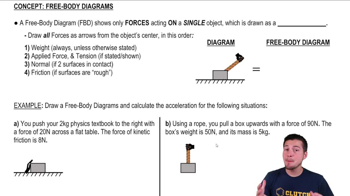
Free-Body Diagram

A free-body diagram is a graphical representation used to visualize the forces acting on an object. It includes all the forces, such as gravitational force, normal force, frictional force, and any applied forces. In this scenario, the diagram will help identify how these forces interact when the conveyor belt accelerates.
Recommended video:
Guided course
08:42
Free-Body Diagrams

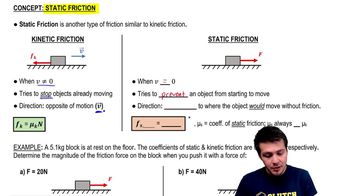
Friction

Friction is the force that opposes the relative motion of two surfaces in contact. It is characterized by two coefficients: static friction (mu(s)), which prevents motion, and kinetic friction (mu(k)), which acts when the object is sliding. Understanding these coefficients is crucial for analyzing the forces on the crate as the conveyor belt speeds up.
Recommended video:
Guided course
08:11
Static Friction & Equilibrium

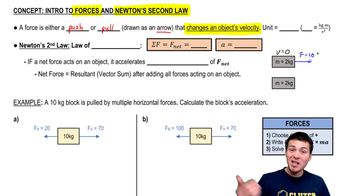
Newton's Second Law

Newton's Second Law states that the acceleration of an object is directly proportional to the net force acting on it and inversely proportional to its mass (F = ma). This principle is essential for determining how the forces on the crate will affect its motion as the conveyor belt accelerates, allowing for the calculation of the net force and resulting acceleration.
Recommended video:
Guided course
06:54
Intro to Forces & Newton's Second Law