Ch 06: Dynamics I: Motion Along a Line
Knight Calc - Physics for Scientists and Engineers 5th Edition
Knight Calc5th EditionPhysics for Scientists and EngineersISBN: 9780137344796Not the one you use?Change textbook
Chapter 6, Problem 29

A rubber-wheeled 50 kg cart rolls down a 15° concrete incline. What is the magnitude of the cart's acceleration if rolling friction is (a) neglected and (b) included?

Verified step by step guidance
1
Step 1: Begin by analyzing the forces acting on the cart. The forces include the gravitational force, the normal force, and rolling friction (if included). The gravitational force can be decomposed into two components: one parallel to the incline and one perpendicular to the incline.
Step 2: Write the equation for the net force along the incline. If rolling friction is neglected, the net force is simply the component of the gravitational force parallel to the incline. This is given by \( F_{\text{parallel}} = m g \sin(\theta) \), where \( m \) is the mass of the cart, \( g \) is the acceleration due to gravity, and \( \theta \) is the angle of the incline.
Step 3: Calculate the acceleration of the cart when rolling friction is neglected. Use Newton's second law \( F = m a \), which gives \( a = g \sin(\theta) \). This is the acceleration due to gravity acting along the incline.
Step 4: If rolling friction is included, account for the frictional force. Rolling friction opposes the motion and is given by \( F_{\text{friction}} = \mu_{r} F_{\text{normal}} \), where \( \mu_{r} \) is the coefficient of rolling friction and \( F_{\text{normal}} = m g \cos(\theta) \) is the normal force. Subtract the rolling friction force from the parallel component of gravity to find the net force: \( F_{\text{net}} = m g \sin(\theta) - \mu_{r} m g \cos(\theta) \).
Step 5: Solve for the acceleration when rolling friction is included. Using Newton's second law again, \( a = \frac{F_{\text{net}}}{m} \), substitute \( F_{\text{net}} \) to get \( a = g \sin(\theta) - \mu_{r} g \cos(\theta) \). This gives the acceleration of the cart considering rolling friction.

Verified video answer for a similar problem:

This video solution was recommended by our tutors as helpful for the problem above.
Video duration:
9m
Was this helpful?

Key Concepts

Here are the essential concepts you must grasp in order to answer the question correctly.

Newton's Second Law of Motion

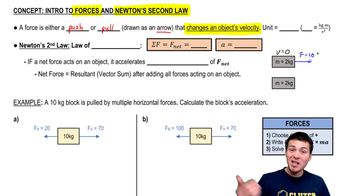
Newton's Second Law states that the acceleration of an object is directly proportional to the net force acting on it and inversely proportional to its mass. This relationship is expressed by the formula F = ma, where F is the net force, m is the mass, and a is the acceleration. Understanding this law is crucial for calculating the acceleration of the cart as it rolls down the incline.
Recommended video:
Guided course
06:54
Intro to Forces & Newton's Second Law

Gravitational Force and Inclined Planes

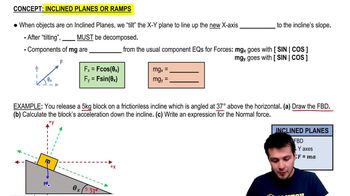
When an object is on an inclined plane, the gravitational force acting on it can be resolved into two components: one parallel to the incline, which causes acceleration, and one perpendicular to the incline, which affects the normal force. The component of gravitational force acting down the incline can be calculated using the angle of the incline, which is essential for determining the cart's acceleration when rolling friction is neglected.
Recommended video:
Guided course
06:59
Intro to Inclined Planes

Rolling Friction

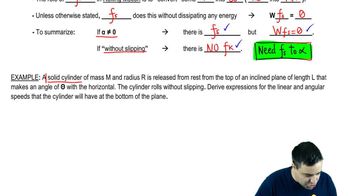
Rolling friction, or rolling resistance, is the force that opposes the motion of a rolling object. It is generally less than sliding friction and depends on factors such as the surface texture and the material of the wheels. When calculating the cart's acceleration with rolling friction included, this force must be subtracted from the net force acting on the cart, affecting the overall acceleration.
Recommended video:
Guided course
12:26
Conservation of Energy in Rolling Motion