Ch 06: Dynamics I: Motion Along a Line
Knight Calc - Physics for Scientists and Engineers 5th Edition
Knight Calc5th EditionPhysics for Scientists and EngineersISBN: 9780137344796Not the one you use?Change textbook
Chapter 6, Problem 23

The mass of the sun is 2.0 x 1030 kg. A 5.0 x 10¹⁴ kg comet is 75 million kilometers from the sun. What is the magnitude of the comet's acceleration toward the sun?

Verified step by step guidance
1
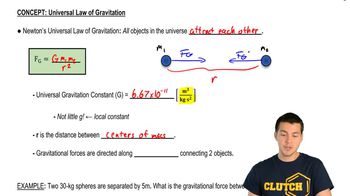
Step 1: Identify the formula for gravitational force, which is given by \( F = \frac{G \cdot m_1 \cdot m_2}{r^2} \), where \( G \) is the gravitational constant \( 6.674 \times 10^{-11} \, \text{N} \cdot \text{m}^2 / \text{kg}^2 \), \( m_1 \) and \( m_2 \) are the masses of the two objects, and \( r \) is the distance between them.
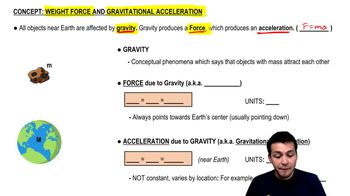
Step 2: Use Newton's second law \( F = m \cdot a \) to relate the gravitational force to the comet's acceleration. Rearrange the formula to solve for acceleration: \( a = \frac{F}{m_2} \).
Step 3: Substitute the expression for gravitational force into the acceleration formula: \( a = \frac{G \cdot m_1}{r^2} \). Here, \( m_1 \) is the mass of the sun, \( m_2 \) cancels out, and \( r \) is the distance between the sun and the comet.
Step 4: Convert the distance \( r \) from kilometers to meters. Since \( 1 \, \text{km} = 1000 \, \text{m} \), \( r = 75 \, \text{million kilometers} = 75 \times 10^6 \, \text{km} \times 1000 \, \text{m/km} = 75 \times 10^9 \, \text{m} \).
Step 5: Substitute the values \( G = 6.674 \times 10^{-11} \, \text{N} \cdot \text{m}^2 / \text{kg}^2 \), \( m_1 = 2.0 \times 10^{30} \, \text{kg} \), and \( r = 75 \times 10^9 \, \text{m} \) into the formula \( a = \frac{G \cdot m_1}{r^2} \). Simplify the expression to find the comet's acceleration.

Verified video answer for a similar problem:

This video solution was recommended by our tutors as helpful for the problem above.
Video duration:
5m
Was this helpful?

Key Concepts

Here are the essential concepts you must grasp in order to answer the question correctly.

Newton's Law of Universal Gravitation

Newton's Law of Universal Gravitation states that every mass attracts every other mass with a force that is directly proportional to the product of their masses and inversely proportional to the square of the distance between their centers. This law is fundamental in calculating gravitational forces, which is essential for determining the acceleration of objects in a gravitational field.
Recommended video:
Guided course
04:05
Universal Law of Gravitation

Gravitational Acceleration

Gravitational acceleration is the acceleration experienced by an object due to the gravitational force exerted by a massive body, such as the sun. It can be calculated using the formula a = F/m, where F is the gravitational force and m is the mass of the object. This concept is crucial for understanding how objects like comets move in space under the influence of gravity.
Recommended video:
Guided course
07:32
Weight Force & Gravitational Acceleration

Distance in Gravitational Calculations

In gravitational calculations, the distance between the centers of two masses is critical, as it affects the gravitational force and, consequently, the acceleration. The distance must be measured in consistent units, typically meters, to ensure accurate calculations. In this question, the distance of 75 million kilometers must be converted to meters to apply the gravitational formulas correctly.
Recommended video:
Guided course
05:41
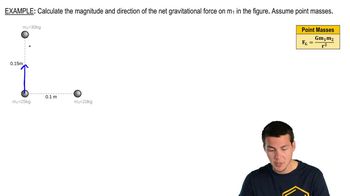
Gravitational Forces in 2D