Ch 06: Dynamics I: Motion Along a Line
Knight Calc - Physics for Scientists and Engineers 5th Edition
Knight Calc5th EditionPhysics for Scientists and EngineersISBN: 9780137344796Not the one you use?Change textbook
Chapter 6, Problem 19

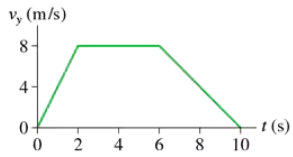
FIGURE EX6.19 shows the velocity graph of a 75 kg passenger in an elevator. What is the passenger's weight at t=1s? At 5 s? At 9 s?

Verified step by step guidance
1
Step 1: Understand the problem. The passenger's weight is affected by the elevator's acceleration. The graph provided shows the velocity of the elevator as a function of time. To find the passenger's weight at specific times, we need to calculate the net force acting on the passenger using Newton's second law, which includes gravitational force and the force due to acceleration.
Step 2: Identify the relationship between acceleration and velocity. Acceleration is the rate of change of velocity with respect to time. Use the formula: a=dvdt. From the graph, determine the slope of the velocity curve at t=1s, t=5s, and t=9s to find the acceleration at these times.
Step 3: Calculate the net force acting on the passenger. The net force is given by: F=ma, where m is the mass of the passenger (75 kg) and a is the acceleration. Add the gravitational force F=mg (where g is 9.8 m/s²) to find the apparent weight.
Step 4: Analyze the graph at t=1s, t=5s, and t=9s. At t=1s, the velocity is increasing, so the elevator is accelerating upward. At t=5s, the velocity is constant, meaning no acceleration. At t=9s, the velocity is decreasing, so the elevator is accelerating downward. Use the slopes of the graph at these points to determine the acceleration values.
Step 5: Combine the forces to find the apparent weight. The apparent weight is the sum of the gravitational force and the force due to acceleration. Use the formula: W=mg+ma for upward acceleration and W=mg-ma for downward acceleration. Substitute the values of acceleration at t=1s, t=5s, and t=9s to find the apparent weight at these times.

Verified video answer for a similar problem:

This video solution was recommended by our tutors as helpful for the problem above.
Video duration:
12m
Was this helpful?

Key Concepts

Here are the essential concepts you must grasp in order to answer the question correctly.

Weight

Weight is the force exerted by gravity on an object, calculated as the product of mass and gravitational acceleration (W = mg). For a 75 kg passenger, the weight can be determined using the standard gravitational acceleration of approximately 9.81 m/s², resulting in a weight of about 735.75 N.
Recommended video:
Guided course
10:19
Torque Due to Weight

Velocity Graph

A velocity graph displays an object's velocity over time, indicating how the object's speed changes. In this case, the graph shows the passenger's velocity in an elevator, with segments representing constant speeds and changes in direction, which are crucial for understanding the forces acting on the passenger at different times.
Recommended video:
Guided course
07:32
Graphing Position, Velocity, and Acceleration Graphs

Net Force and Acceleration

Net force is the total force acting on an object, which determines its acceleration according to Newton's second law (F = ma). In the context of the elevator, the net force on the passenger changes with the elevator's acceleration, affecting the apparent weight felt by the passenger at different times, particularly during acceleration and deceleration.
Recommended video:
Guided course
07:32
Weight Force & Gravitational Acceleration