Ch 06: Dynamics I: Motion Along a Line
Knight Calc - Physics for Scientists and Engineers 5th Edition
Knight Calc5th EditionPhysics for Scientists and EngineersISBN: 9780137344796Not the one you use?Change textbook
Chapter 6, Problem 18a

It takes the elevator in a skyscraper 4.0 s to reach its cruising speed of 10 m/s. A 60 kg passenger gets aboard on the ground floor. What is the passenger's weight before the elevator starts moving?

Verified step by step guidance
1
Determine the passenger's weight before the elevator starts moving. Weight is the force due to gravity acting on the passenger, which is calculated using the formula: W=mg, where m is the mass of the passenger and g is the acceleration due to gravity.
Substitute the given values into the formula. The mass of the passenger is 60 kg, and the acceleration due to gravity is approximately 9.8 m/s².
Perform the multiplication: W=60×9.8. This will give the weight of the passenger in newtons (N).
Since the elevator has not started moving yet, there are no additional forces acting on the passenger other than gravity. Therefore, the calculated weight is the passenger's weight before the elevator starts moving.
Conclude that the passenger's weight before the elevator starts moving is solely determined by the gravitational force acting on their mass.

Verified video answer for a similar problem:

This video solution was recommended by our tutors as helpful for the problem above.
Video duration:
3m
Was this helpful?

Key Concepts

Here are the essential concepts you must grasp in order to answer the question correctly.

Weight

Weight is the force exerted by gravity on an object, calculated as the product of mass and the acceleration due to gravity. It is given by the formula W = mg, where W is weight, m is mass, and g is approximately 9.81 m/s² on the surface of the Earth. For a 60 kg passenger, their weight can be determined by multiplying their mass by the gravitational acceleration.
Recommended video:
Guided course
10:19
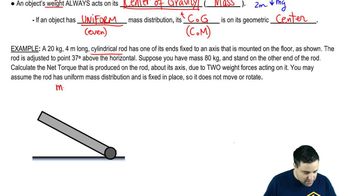
Torque Due to Weight

Mass

Mass is a measure of the amount of matter in an object, typically measured in kilograms. Unlike weight, mass does not change regardless of the object's location in the universe. It is a scalar quantity and is fundamental in determining the weight of an object when combined with the acceleration due to gravity.
Recommended video:
Guided course
20:32
Mass Spectrometers

Gravitational Acceleration

Gravitational acceleration is the acceleration experienced by an object due to the force of gravity. On Earth, this value is approximately 9.81 m/s², meaning that an object will accelerate downwards at this rate if in free fall. This constant is crucial for calculating weight, as it directly influences the force exerted on an object's mass.
Recommended video:
Guided course
07:32
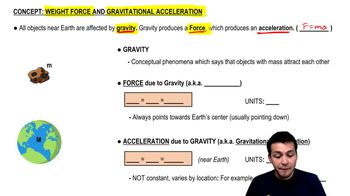
Weight Force & Gravitational Acceleration