Ch 22: Electric Charges and Forces
Knight Calc - Physics for Scientists and Engineers 5th Edition
Knight Calc5th EditionPhysics for Scientists and EngineersISBN: 9780137344796Not the one you use?Change textbook
Chapter 22, Problem 29d

The electric field at a point in space is E=(400i^+100j^)E=(400\(\hat{i}\)+100\(\hat{j}\)) N/C. What is the magnitude of the electron’s acceleration?

Verified step by step guidance
1
Step 1: Recall the relationship between force and electric field. The force experienced by a charged particle in an electric field is given by the equation: F=qE, where q is the charge of the particle and E is the electric field vector.
Step 2: Substitute the charge of an electron into the equation. The charge of an electron is q=-1.6×10⁻¹⁹ C. The electric field vector is given as E=(400î+100ĵ) N/C.
Step 3: Calculate the force vector. Using the equation F=qE, multiply the charge of the electron by each component of the electric field vector. This will give the force vector F=(Fî,Fĵ).
Step 4: Use Newton's second law to find the acceleration. Newton's second law states that F=ma, where m is the mass of the electron and a is the acceleration. Rearrange this equation to solve for acceleration: a=F/m. The mass of an electron is m=9.11×10⁻³¹ kg.
Step 5: Calculate the magnitude of the acceleration. First, find the magnitude of the force vector using the Pythagorean theorem: |F|=Fî2+Fĵ2. Then, divide the magnitude of the force by the mass of the electron to find the magnitude of the acceleration: |a|=|F|/m.

Verified video answer for a similar problem:

This video solution was recommended by our tutors as helpful for the problem above.
Video duration:
3m
Was this helpful?

Key Concepts

Here are the essential concepts you must grasp in order to answer the question correctly.

Electric Field

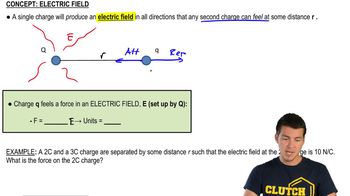
An electric field is a vector field surrounding electric charges that exerts a force on other charges within the field. It is represented by the symbol E and is measured in newtons per coulomb (N/C). The direction of the electric field is defined as the direction of the force it would exert on a positive test charge.
Recommended video:
Guided course
03:16
Intro to Electric Fields

Force on a Charge

The force experienced by a charge in an electric field can be calculated using Coulomb's law, given by F = qE, where F is the force, q is the charge, and E is the electric field strength. For an electron, which has a negative charge, the force will be in the opposite direction of the electric field.
Recommended video:
Guided course
06:21
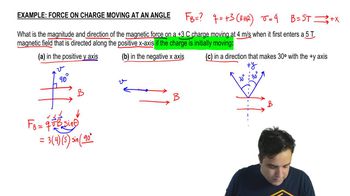
Force on Charge Moving at an Angle

Newton's Second Law of Motion

Newton's Second Law states that the acceleration of an object is directly proportional to the net force acting on it and inversely proportional to its mass, expressed as F = ma. This principle allows us to calculate the acceleration of the electron once the force acting on it is determined from the electric field.
Recommended video:
Guided course
06:54
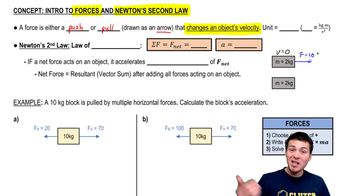
Intro to Forces & Newton's Second Law