Ch 30: Electromagnetic Induction
Knight Calc - Physics for Scientists and Engineers 5th Edition
Knight Calc5th EditionPhysics for Scientists and EngineersISBN: 9780137344796Not the one you use?Change textbook
Chapter 30, Problem 71b

An LC circuit is built with a 20 mH inductor and an 8.0 pF capacitor. The capacitor voltage has its maximum value of 25 V at t = 0 s. What is the inductor current at that time?

Verified step by step guidance
1
Step 1: Understand the problem. The LC circuit consists of an inductor and a capacitor. At t = 0 s, the capacitor voltage is at its maximum value, which means the energy in the circuit is entirely stored in the capacitor. The inductor current at this moment is zero because the energy has not yet transferred to the inductor.
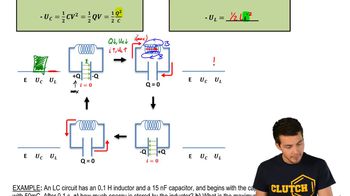
Step 2: Recall the energy conservation principle in an LC circuit. The total energy in the circuit remains constant and is shared between the capacitor and the inductor. The energy stored in the capacitor is given by the formula: EC=12CV2, where C is the capacitance and V is the voltage across the capacitor.
Step 3: Substitute the given values into the capacitor energy formula. The capacitance is 8.0×10⁻¹² F, and the voltage is 25 V. Calculate the energy stored in the capacitor at t = 0 s.
Step 4: Recognize that at t = 0 s, the inductor current is zero because the energy is entirely stored in the capacitor. The current in the inductor will begin to increase as the energy oscillates between the capacitor and the inductor over time.
Step 5: Conclude that the inductor current at t = 0 s is 0 A, based on the initial conditions of the LC circuit and the energy distribution.

Verified video answer for a similar problem:

This video solution was recommended by our tutors as helpful for the problem above.
Video duration:
7m
Was this helpful?

Key Concepts

Here are the essential concepts you must grasp in order to answer the question correctly.

LC Circuit

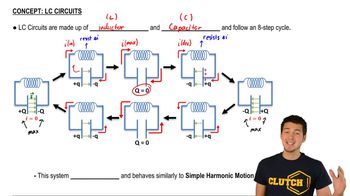
An LC circuit consists of an inductor (L) and a capacitor (C) connected together, forming a resonant circuit. It oscillates between the energy stored in the electric field of the capacitor and the magnetic field of the inductor. The behavior of the circuit is characterized by its natural frequency, which depends on the values of L and C.
Recommended video:

Inductor Current

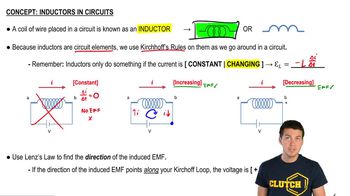
In an LC circuit, the inductor current represents the flow of electric charge through the inductor. At the moment when the capacitor voltage is at its maximum, the inductor current is at its minimum, which is zero. This is because the energy is fully stored in the capacitor, and the inductor has not yet begun to release its stored energy.
Recommended video:
Guided course
07:10
Inductors in Circuits

Energy Conservation in LC Circuits

Energy conservation in LC circuits is a fundamental principle where the total energy oscillates between the capacitor and the inductor. At maximum capacitor voltage, all energy is stored in the capacitor, while at maximum inductor current, all energy is stored in the inductor. This interplay allows for continuous oscillation, with energy shifting back and forth between the two components.
Recommended video:
Guided course
10:07
Energy in an LC Circuit