
Textbook Question
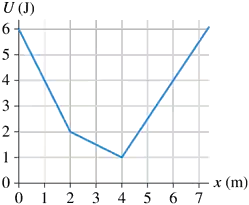
FIGURE EX10.28 shows the potential-energy diagram for a 500 g particle as it moves along the x-axis. Suppose the particle's mechanical energy is 12 J. Where are the particle's turning points?
2
views

 Verified step by step guidance
 07:24
07:24
 06:24
06:24 06:07
06:07FIGURE EX10.28 shows the potential-energy diagram for a 500 g particle as it moves along the x-axis. Suppose the particle's mechanical energy is 12 J. Where are the particle's turning points?
In FIGURE EX10.27, what is the maximum speed of a 2.0 g particle that oscillates between x = 2.0 mm and x = 8.0 mm
The elastic energy stored in your tendons can contribute up to 35% of your energy needs when running. Sports scientists find that (on average) the knee extensor tendons in sprinters stretch 41 mm while those of nonathletes stretch only 33 mm. The spring constant of the tendon is the same for both groups, 33 N/mm. What is the difference in maximum stored energy between the sprinters and the nonathletes?
In FIGURE EX10.26, What minimum speed does a 100 g particle need at point B to reach point A?
As a 15,000 kg jet plane lands on an aircraft carrier, its tail hook snags a cable to slow it down. The cable is attached to a spring with spring constant 60,000 N/m. If the spring stretches 30 m to stop the plane, what was the plane's landing speed?
FIGURE EX10.24 is the potential-energy diagram for a 500 g particle that is released from rest at A. What are the particle's speeds at B, C, and D?