Ch 10: Interactions and Potential Energy
Knight Calc - Physics for Scientists and Engineers 5th Edition
Knight Calc5th EditionPhysics for Scientists and EngineersISBN: 9780137344796Not the one you use?Change textbook
Chapter 10, Problem 26b

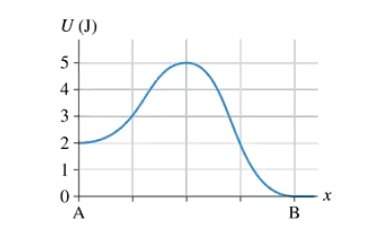
In FIGURE EX10.26, What minimum speed does a 100 g particle need at point B to reach point A?

Verified step by step guidance
1
Step 1: Analyze the graph provided. The graph shows the potential energy U(x) as a function of position x. At point A, the potential energy is approximately 2 J, and at point B, the potential energy is 0 J. The peak of the potential energy curve is around 5 J.
Step 2: Use the principle of conservation of mechanical energy. The total mechanical energy (kinetic energy + potential energy) at point B must be equal to the total mechanical energy at point A for the particle to reach point A.
Step 3: Write the equation for conservation of energy: \( K_B + U_B = K_A + U_A \), where \( K_B \) and \( K_A \) are the kinetic energies at points B and A, and \( U_B \) and \( U_A \) are the potential energies at points B and A.
Step 4: At point A, the particle must have zero kinetic energy to just reach the point (minimum speed condition). Thus, \( K_A = 0 \). Substitute \( U_B = 0 \) and \( U_A = 2 \) J into the equation: \( K_B = U_A - U_B \).
Step 5: Express \( K_B \) in terms of the particle's mass and velocity: \( K_B = \frac{1}{2}mv^2 \). Solve for the velocity \( v \) using \( v = \sqrt{\frac{2(U_A - U_B)}{m}} \), where \( m = 0.1 \) kg (converted from 100 g).

Verified video answer for a similar problem:

This video solution was recommended by our tutors as helpful for the problem above.
Was this helpful?

Key Concepts

Here are the essential concepts you must grasp in order to answer the question correctly.

Potential Energy

Potential energy (U) is the energy stored in an object due to its position in a force field, commonly gravitational or elastic. In the context of the graph, it represents the energy of the particle at points A and B, where the height of the curve indicates the potential energy at those positions. Understanding how potential energy changes as the particle moves is crucial for determining the minimum speed required to reach point A.
Recommended video:
Guided course
07:24
Potential Energy Graphs

Conservation of Energy

The principle of conservation of energy states that the total energy in a closed system remains constant. In this scenario, the sum of kinetic energy (KE) and potential energy (PE) at point B must equal the potential energy at point A. This relationship allows us to calculate the minimum speed needed at point B by equating the energies at both points.
Recommended video:
Guided course
06:24
Conservation Of Mechanical Energy

Kinetic Energy

Kinetic energy (KE) is the energy an object possesses due to its motion, calculated using the formula KE = 1/2 mv², where m is mass and v is velocity. To find the minimum speed at point B, we need to determine how much kinetic energy is required to convert into potential energy as the particle moves to point A. This concept is essential for solving the problem by linking speed to energy.
Recommended video:
Guided course
06:07
Intro to Rotational Kinetic Energy