Ch 10: Interactions and Potential Energy
Knight Calc - Physics for Scientists and Engineers 5th Edition
Knight Calc5th EditionPhysics for Scientists and EngineersISBN: 9780137344796Not the one you use?Change textbook
Chapter 10, Problem 23

The elastic energy stored in your tendons can contribute up to 35% of your energy needs when running. Sports scientists find that (on average) the knee extensor tendons in sprinters stretch 41 mm while those of nonathletes stretch only 33 mm. The spring constant of the tendon is the same for both groups, 33 N/mm. What is the difference in maximum stored energy between the sprinters and the nonathletes?

Verified step by step guidance
1
The elastic potential energy stored in a spring (or tendon, in this case) is given by the formula: Uelastic = 12kx2, where k is the spring constant and x is the stretch (displacement) of the spring.
Substitute the given values for the sprinters into the formula. The spring constant is k = 33 N/mm, and the stretch is x = 41 mm. The elastic energy for sprinters is: Usprinters = 12kx2.
Substitute the given values for the nonathletes into the formula. The spring constant is the same, k = 33 N/mm, and the stretch is x = 33 mm. The elastic energy for nonathletes is: Unonathletes = 12kx2.
To find the difference in maximum stored energy between the sprinters and the nonathletes, calculate: ΔU = Usprinters - Unonathletes. Substitute the expressions for Usprinters and Unonathletes into this equation.
Simplify the expression for ΔU to find the difference in elastic energy. Ensure that the units are consistent throughout the calculation (N·mm or J).

Verified video answer for a similar problem:

This video solution was recommended by our tutors as helpful for the problem above.
Video duration:
7m
Was this helpful?

Key Concepts

Here are the essential concepts you must grasp in order to answer the question correctly.

Elastic Potential Energy

Elastic potential energy is the energy stored in elastic materials as the result of their stretching or compressing. It can be calculated using the formula E = 1/2 k x², where E is the elastic potential energy, k is the spring constant, and x is the displacement from the equilibrium position. This concept is crucial for understanding how tendons store energy during activities like running.
Recommended video:
Guided course
07:24
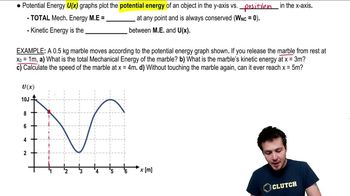
Potential Energy Graphs

Spring Constant

The spring constant, denoted as k, is a measure of a spring's stiffness, defined as the force required to stretch or compress the spring by a unit distance. In this context, the spring constant of the tendons is the same for both sprinters and nonathletes, indicating that the energy stored in the tendons depends on how much they are stretched, rather than their stiffness.
Recommended video:
Guided course
08:59
Phase Constant of a Wave Function

Displacement in Tendons

Displacement refers to the amount by which a tendon is stretched from its natural length. In this scenario, sprinters' tendons stretch 41 mm while nonathletes' tendons stretch 33 mm. The difference in displacement directly affects the amount of elastic potential energy stored, making it a key factor in calculating the energy differences between the two groups.
Recommended video:
Guided course
06:13
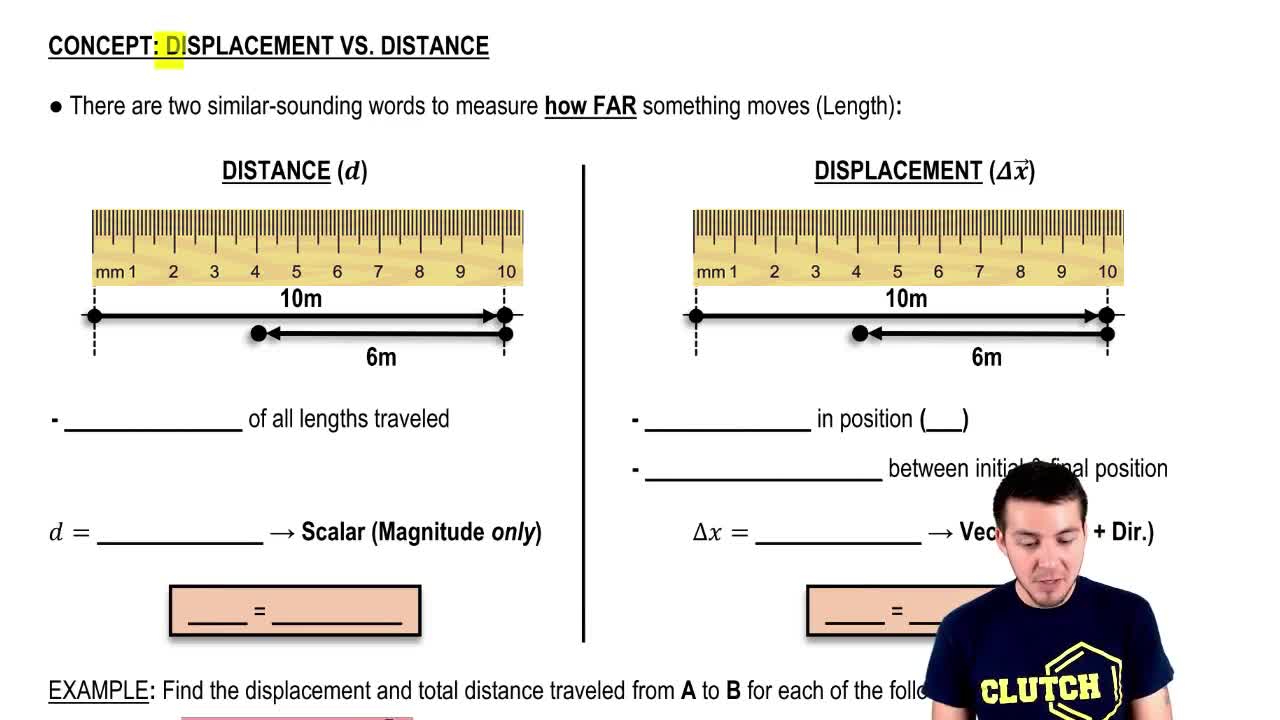
Displacement vs. Distance