
The elastic energy stored in your tendons can contribute up to 35% of your energy needs when running. Sports scientists find that (on average) the knee extensor tendons in sprinters stretch 41 mm while those of nonathletes stretch only 33 mm. The spring constant of the tendon is the same for both groups, 33 N/mm. What is the difference in maximum stored energy between the sprinters and the nonathletes?
A stretched spring stores 2.0 J of energy. How much energy will be stored if the spring is stretched three times as far?
Verified step by step guidance
Verified video answer for a similar problem:
Key Concepts
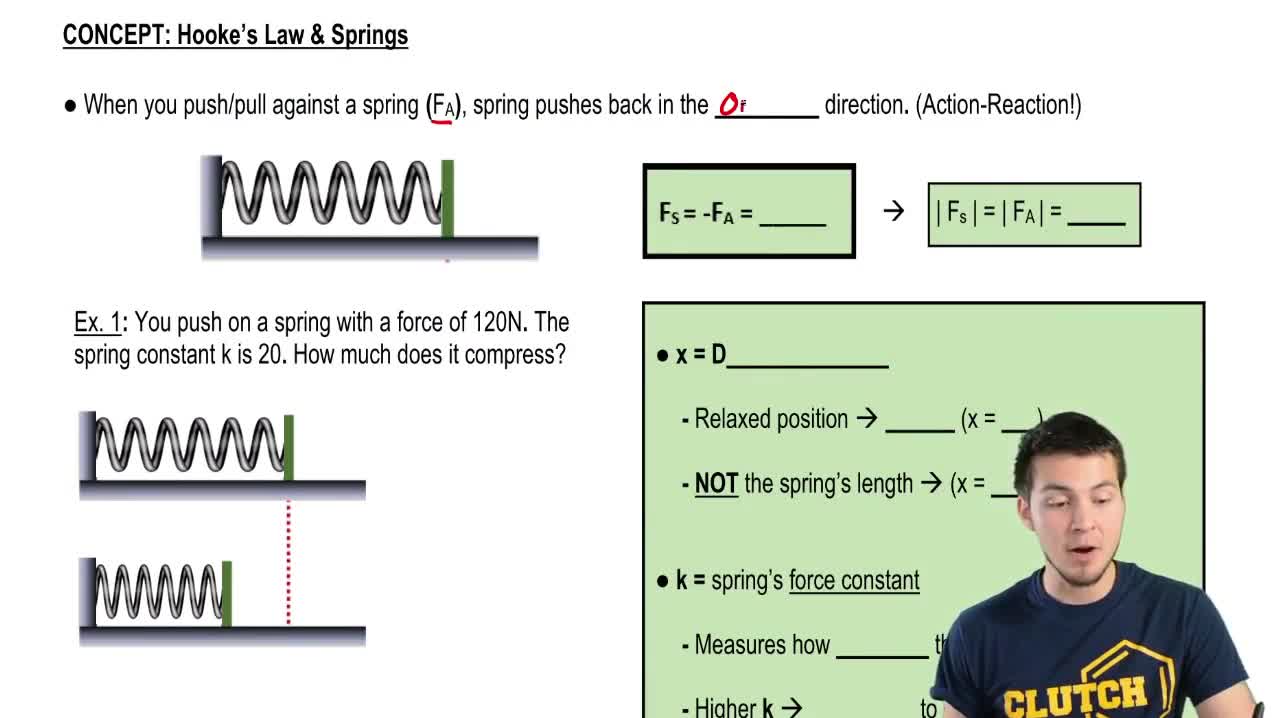
Hooke's Law
Elastic Potential Energy
Energy Scaling with Displacement
As a 15,000 kg jet plane lands on an aircraft carrier, its tail hook snags a cable to slow it down. The cable is attached to a spring with spring constant 60,000 N/m. If the spring stretches 30 m to stop the plane, what was the plane's landing speed?
The maximum energy a bone can absorb without breaking is surprisingly small. Experimental data show that a leg bone of a healthy, 60 kg human can absorb about 200 J. From what maximum height could a 60 kg person jump and land rigidly upright on both feet without breaking his legs? Assume that all energy is absorbed by the leg bones in a rigid landing.
FIGURE EX10.24 is the potential-energy diagram for a 500 g particle that is released from rest at A. What are the particle's speeds at B, C, and D?
In a hydroelectric dam, water falls 25 m and then spins a turbine to generate electricity. Suppose the dam is 80% efficient at converting the water's potential energy to electrical energy. How many kilograms of water must pass through the turbines each second to generate 50 MW of electricity? This is a typical value for a small hydroelectric dam.
In a hydroelectric dam, water falls 25 m and then spins a turbine to generate electricity. What is of 1.0 kg of water?
