
Ch 10: Interactions and Potential Energy
Knight Calc - Physics for Scientists and Engineers 5th Edition
Knight Calc5th EditionPhysics for Scientists and EngineersISBN: 9780137344796Not the one you use?Change textbook
Chapter 10, Problem 19

As a 15,000 kg jet plane lands on an aircraft carrier, its tail hook snags a cable to slow it down. The cable is attached to a spring with spring constant 60,000 N/m. If the spring stretches 30 m to stop the plane, what was the plane's landing speed?

Verified step by step guidance
1
Step 1: Recognize that the problem involves energy conservation. The plane's kinetic energy is converted into elastic potential energy stored in the spring as it stretches. Use the principle of energy conservation: \( KE_{initial} = PE_{spring} \).
Step 2: Write the formula for the plane's initial kinetic energy: \( KE_{initial} = \frac{1}{2} m v^2 \), where \( m \) is the mass of the plane (15,000 kg) and \( v \) is its landing speed.
Step 3: Write the formula for the elastic potential energy stored in the spring: \( PE_{spring} = \frac{1}{2} k x^2 \), where \( k \) is the spring constant (60,000 N/m) and \( x \) is the stretch of the spring (30 m).
Step 4: Set \( KE_{initial} \) equal to \( PE_{spring} \): \( \frac{1}{2} m v^2 = \frac{1}{2} k x^2 \). Cancel out the \( \frac{1}{2} \) on both sides to simplify the equation to \( m v^2 = k x^2 \).
Step 5: Solve for \( v \) (the landing speed of the plane) by isolating \( v \): \( v = \sqrt{\frac{k x^2}{m}} \). Substitute the given values for \( k \), \( x \), and \( m \) into the equation to calculate \( v \).

Verified video answer for a similar problem:

This video solution was recommended by our tutors as helpful for the problem above.
Video duration:
4m
Was this helpful?

Key Concepts

Here are the essential concepts you must grasp in order to answer the question correctly.

Conservation of Energy

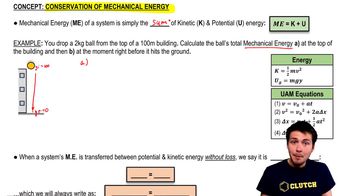
The principle of conservation of energy states that energy cannot be created or destroyed, only transformed from one form to another. In this scenario, the kinetic energy of the jet plane as it lands is converted into elastic potential energy stored in the spring when it stretches. Understanding this relationship allows us to equate the initial kinetic energy of the plane to the potential energy in the spring at maximum stretch.
Recommended video:
Guided course
06:24
Conservation Of Mechanical Energy

Kinetic Energy

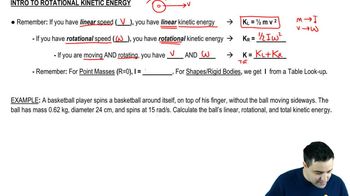
Kinetic energy is the energy possessed by an object due to its motion, calculated using the formula KE = 1/2 mv², where m is the mass and v is the velocity of the object. In this case, the jet plane's landing speed is directly related to its kinetic energy, which must be determined to find how fast the plane was moving before it engaged the spring system.
Recommended video:
Guided course
06:07
Intro to Rotational Kinetic Energy

Elastic Potential Energy

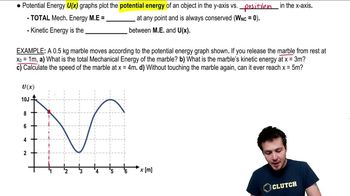
Elastic potential energy is the energy stored in elastic materials as the result of their stretching or compressing. It can be calculated using the formula PE = 1/2 kx², where k is the spring constant and x is the displacement from the equilibrium position. In this problem, the spring's stretch provides a means to quantify the energy absorbed from the plane's motion, allowing for the calculation of the initial speed.
Recommended video:
Guided course
07:24
Potential Energy Graphs