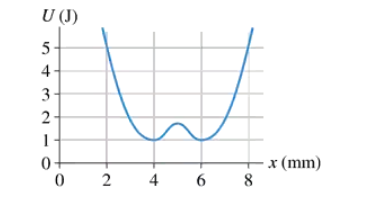
FIGURE EX10.28 shows the potential-energy diagram for a 500 g particle as it moves along the x-axis. Suppose the particle's mechanical energy is 12 J. Where are the particle's turning points?
Ch 10: Interactions and Potential Energy
Knight Calc5th EditionPhysics for Scientists and EngineersISBN: 9780137344796Not the one you use?Change textbook
Chapter 10, Problem 27
In FIGURE EX10.27, what is the maximum speed of a 2.0 g particle that oscillates between x = 2.0 mm and x = 8.0 mm

Verified step by step guidance1
Determine the amplitude of the oscillation. The amplitude is the maximum displacement from the equilibrium position. In this case, the particle oscillates between x = 2.0 mm and x = 8.0 mm, so the equilibrium position is the midpoint: \( x_{eq} = \frac{2.0 \text{ mm} + 8.0 \text{ mm}}{2} \). The amplitude \( A \) is then \( A = 8.0 \text{ mm} - x_{eq} \).
Recall the formula for the maximum speed of a particle in simple harmonic motion: \( v_{max} = \omega A \), where \( \omega \) is the angular frequency and \( A \) is the amplitude. To calculate \( v_{max} \), we need to find \( \omega \).
The angular frequency \( \omega \) is related to the mass \( m \) and the spring constant \( k \) by the formula \( \omega = \sqrt{\frac{k}{m}} \). If the spring constant \( k \) is not provided, it must be determined or assumed based on additional context.
Substitute the values of \( \omega \) and \( A \) into the formula \( v_{max} = \omega A \). Ensure that the amplitude \( A \) is converted to meters (SI units) before performing the calculation.
Simplify the expression to find the maximum speed \( v_{max} \). Remember to keep the units consistent throughout the calculation.

Verified video answer for a similar problem:
This video solution was recommended by our tutors as helpful for the problem above.
Video duration:
6mWas this helpful?
Key Concepts
Here are the essential concepts you must grasp in order to answer the question correctly.
Simple Harmonic Motion (SHM)
Simple Harmonic Motion is a type of periodic motion where an object oscillates around an equilibrium position. The motion is characterized by a restoring force proportional to the displacement from the equilibrium, leading to sinusoidal motion. In this context, the particle's oscillation between two positions indicates it is undergoing SHM.
Recommended video:
Guided course
Simple Harmonic Motion of Pendulums
Maximum Speed in SHM
In Simple Harmonic Motion, the maximum speed of an oscillating particle occurs as it passes through the equilibrium position. This speed can be calculated using the formula v_max = ωA, where ω is the angular frequency and A is the amplitude of the motion. Understanding this relationship is crucial for determining the particle's maximum speed.
Recommended video:
Guided course
Speed Distribution & Special Speeds of Ideal Gases
Amplitude
Amplitude in the context of oscillation refers to the maximum displacement of the particle from its equilibrium position. It is half the distance between the maximum and minimum positions of the oscillation. For the given problem, the amplitude can be calculated as half the difference between the two positions (8.0 mm and 2.0 mm), which is essential for finding the maximum speed.
Recommended video:
Guided course
Amplitude Decay in an LRC Circuit
Related Practice
Textbook Question
2
views
Textbook Question
A system in which only one particle moves has the potential energy shown in FIGURE EX10.31. What is the x-component of the force on the particle at x = 5, 15, and 25 cm?
1
views
Textbook Question
In FIGURE EX10.26, What minimum speed does a 100 g particle need at point B to reach point A?
2
views
Textbook Question
FIGURE EX10.24 is the potential-energy diagram for a 500 g particle that is released from rest at A. What are the particle's speeds at B, C, and D?
1
views
Textbook Question
In FIGURE EX10.28, what is the maximum speed a 200 g particle could have at x = 2.0 m and never reach x = 6.0 m?
1
views
Textbook Question
FIGURE EX10.25 is the potential-energy diagram for a 20 g particle that is released from rest at x = 1.0 m. What is the particle's maximum speed? At what position does it have this speed?
1
views